
By Chen Ming, Senior Fabrication Engineer · Updated September 7, 2026 · 8 min read
Custom stainless steel gutters succeed or fail on four spec choices: grade (304 vs 316L), thickness against support spacing, the number of field joints, and weld quality at corners. Get those right and a drainage run goes 30 years with no maintenance. Get them wrong and the first callback lands inside two winters. This guide covers what to specify, and what to ask a China fabricator, before you place the order.
1. Grade × thickness decision: 304 vs 316L
The grade decision is driven by chlorides, not habit. For inland projects with clean rainwater, 304 (UNS S30400) is the default, with decades of proven eaves service.
Two environments change the answer: coastal zones with salt spray, roughly anything within 5 km of open sea, and sites where road de-icing salts aerosolize onto the facade.
For those, specify 316L (UNS S31603). Its 2.0-3.0 % molybdenum raises pitting resistance, PREN around 24-26 versus 18-20 for 304, and the low-carbon chemistry protects the weld zones. Our 304L vs 316L comparison walks through the full corrosion logic.
The molybdenum premium is real. 316L coil typically runs 15-25 % above 304 and moves with alloy surcharges, so spec it where chlorides are present rather than by default.
Order sheet and coil to ASTM A240/A240M, the standard specification for chromium-nickel stainless plate, sheet and strip. It pins chemistry and mechanical properties, and it is the document a credible mill test certificate references. ASTM International maintains the spec.
Thickness is a structural decision, not a cosmetic one. It sets deflection under water and snow load, dent resistance under maintenance foot traffic, and the longest single piece that survives bending and transport. Three inputs govern: support spacing, design flow, and snow load.
| Thickness | Recommended grade | Support spacing | Typical application | Standard ref |
|---|---|---|---|---|
| 0.5-0.6 mm | 304 | ≤ 600 mm | Light commercial eaves, hidden liner runs | ASTM A240 |
| 0.7-0.8 mm | 304 / 316L | 600-900 mm | Exposed architectural eaves gutters | ASTM A240 |
| 1.0 mm | 304 / 316L | 900-1,200 mm | High-flow box gutters, snow-load regions | ASTM A240 |
| 1.2 mm | 316L preferred | ≥ 1,200 mm | Parapet and valley gutters, maintenance foot traffic | ASTM A240 |
Two shop-floor notes. Above 1.0 mm, springback on long bends becomes visible, and the operator compensates bend angle batch by batch, which we cover in the bending section below. And do not thin-spec hidden runs to save money: a concealed gutter that leaks inside a wall costs 20x the material saving to fix.
Where your project cites EN 612-style eaves shape and flow classes, send us the reference. Chinese shops do not fabricate to EN 612 natively, but we match profile and hook spacing to it.
2. Extra-long single-piece bending: fewer joints, fewer leaks
This is the spec lever almost nobody discusses, and it separates gutter fabricators from each other. Every joint in a run is a leak point: sealant ages, thermal movement works it, debris abrades it.
Austenitic stainless expands about 17 µm per meter per kelvin, so a 10 m run cycling through a 60 °C seasonal swing moves about 10 mm. Joints have to absorb that movement. A single-piece bend simply flexes.
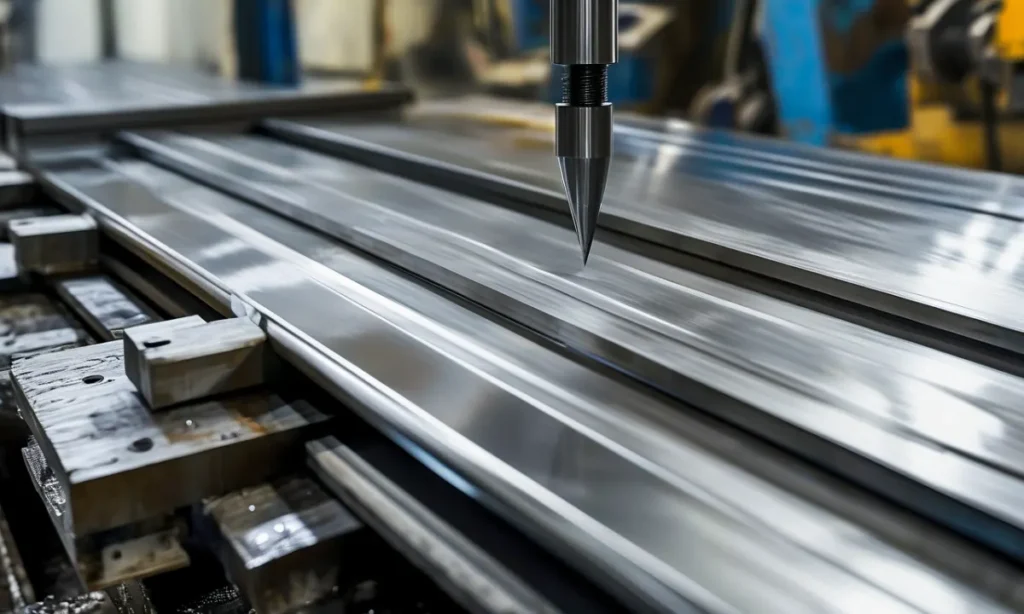
Bending gutters beyond 8 m in one piece is hard because the equipment is rare. It takes a large CNC press brake with a matching bed and, just as important, support arms that carry the long thin part before, during and after the bend.
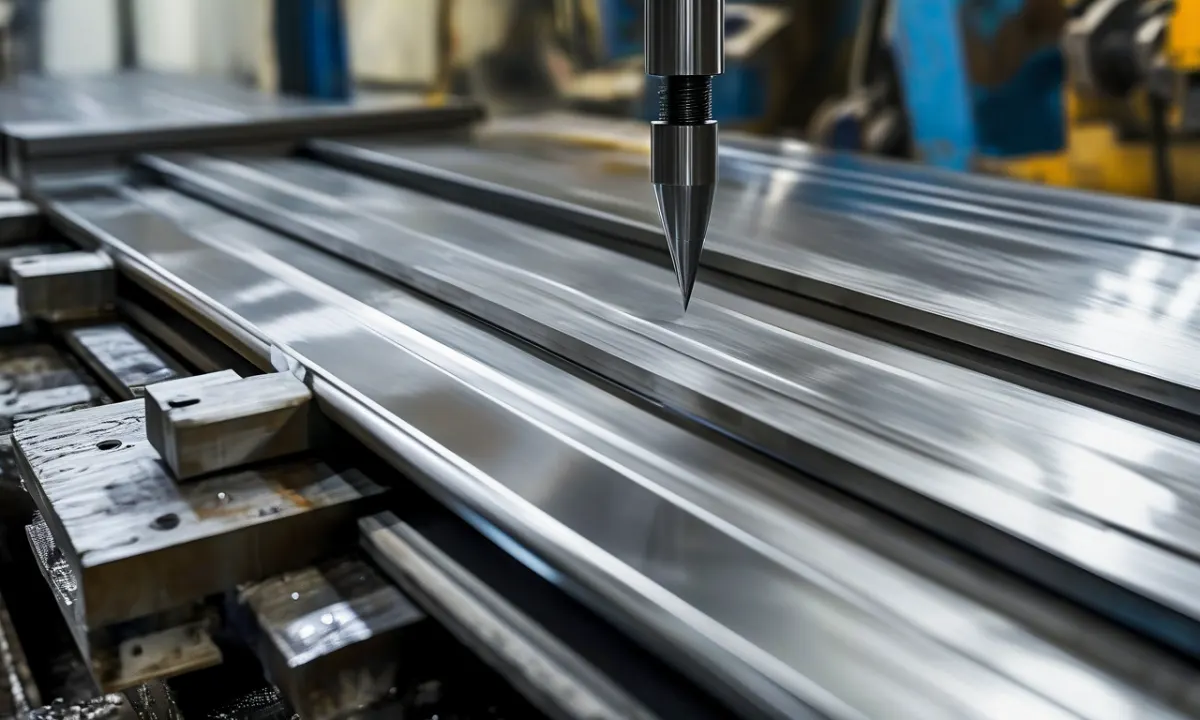
On our floor these long sections run across the large press brake below, supported end to end so the profile does not bow under its own weight.
Practical maximum length is set by physics and by containers. Thin-walled parts oil-can and twist in handling, so we recommend conservative limits by thickness. Sea freight adds a hard cap: a 40 ft HC container is about 12.03 m long inside, so anything longer means flat-rack or break-bulk rates.
| Thickness | Grade | Practical max one-piece length | Length tolerance | Handling note |
|---|---|---|---|---|
| 0.6 mm | 304 / 316L | about 6 m | ±2 mm | Oil-canning risk; brace mid-span for transport |
| 0.8 mm | 304 / 316L | about 8 m | ±2 mm | Standard choice for long architectural runs |
| 1.0 mm | 304 / 316L | 10 m+ | ±3 mm | Fits a 40 ft HC container |
| 1.2 mm | 316L | 12 m (container limit) | ±3 mm | Heavy; strap or crane lifting only |
Beyond length tolerance, spec straightness of 2 mm/m or better and cross-section within ±0.5 mm, so outlets land on downpipe centers on site.
Why does this belong in your RFQ? Long seamless gutters are the highest-risk, highest-margin item on any gutter schedule.
A shop that prices them cheaply either lacks the equipment and will quietly deliver jointed sections, or it will generate your field leak callbacks. Ask directly: what is the longest single piece you can bend, and how will you pack it? Tooling and springback compensation for long bends are covered in our CNC stainless steel bending guide.
3. Welded vs seamless-formed: where gutter corrosion starts
Inspect failed gutters and the pattern is consistent: corrosion starts at the weld seam, not the sheet. Two mechanisms are at work.
First, sensitization: welding a standard-carbon grade precipitates chromium carbides in the heat-affected zone and drains local corrosion resistance. Second, crevices: undercut, lack-of-penetration welds and spatter trap debris and moisture, then crevice-corrode under chlorides.
The countermeasure starts at order entry. Specify low-carbon 304L/316L (C ≤ 0.03 %) for any welded gutter; the L grades largely eliminate sensitization at the weld.
Then match construction to location. Long straight runs should be seamless-formed, folded from a single blank with no longitudinal weld. Welds belong at corners, outlets and end caps only.
For visible architectural corners, spec TIG (GTAW) with full penetration, then pickling and passivation. MIG is acceptable on hidden drainage runs at 1.0 mm and above, where cosmetic spatter can be ground clean. The trade-offs are detailed in our stainless steel welding process selection guide.

Corner joint weld quality is what you are really buying. Spec full penetration at corner seams, no undercut or pinholes visible to the eye, and dye-penetrant (PT) checks on corners for critical architectural work.
Leave a weld seam brown with heat tint and it will rust-stain the facade within a season. Pickling and passivation restore the chromium-oxide layer before packing.
4. Surface finish and corrosion protection
Finish splits by visibility. Exposed architectural gutters, the visible fascia line on a building, usually spec brushed No. 4 (typically Ra 0.4-1.0 µm), which hides handling scratches and matches cladding trim. Landmark facades sometimes go mirror 8K.
Hidden drainage runs need only 2B mill finish (Ra around 0.1-0.5 µm): smooth enough to shed debris and cheaper to produce. You can even order different finishes per face, No. 4 outside and 2B inside. The British Stainless Steel Association publishes practical guidance on architectural stainless finishes.

Gutters are debris holders, and debris holds moisture, which is a recipe for crevice corrosion. Mitigate in the spec: minimum fall of 1:350 toward outlets, no dead-flat runs, leaf guards on tree-lined elevations.
On coastal projects, the leaf pile-up on a 304 gutter is exactly where pitting starts, one more argument for 316L in salt zones. SSINA publishes a solid primer on stainless corrosion behavior.
Protection during fabrication and transport matters as much as alloy. Visible faces should carry a 50-80 µm PVC film from cutting through bending and shipping; the film burns off at weld zones, so spec re-protection after weld cleanup.
On site, remove the film within about 90 days. UV bakes the adhesive onto the surface, and sun-baked film needs solvents you do not want on a finished facade.
5. Importing from China: the sourcing facts
Gutter fabrication is one of the better-value categories to source from China. Profile bending and welding are equipment- and labor-driven, not IP-driven. Here is what a serious RFQ looks like.
Drawings. Send DXF or STEP of the profile plus a length list and quantity breakdown. A shop running fiber lasers nests directly from DXF; our fiber laser cutting guide shows why DXF beats PDF for nesting. A dimensioned 2D PDF is acceptable but expect clarification questions. A shop that asks none is usually not reading your drawing.
MOQ and lead time. For custom-bent profiles, 200-500 linear meters is a typical production minimum; shorter runs are usually quoted as a lot price. Mixing 2-3 profiles in one batch is normally fine. Realistic lead time is 15-30 days from drawing approval, longer when large areas of No. 4 polishing are involved.
Verification. Demand an MTC per EN 10204 3.1 tied to the coil heat number, and PMI on 316L lots: molybdenum detection is exactly where 304/316L mix-ups get caught. Third-party inspection should be welcomed, not negotiated. Our MTR verification guide shows how to read the certificate line by line.
Packing and shipping. PVC film stays on, corners get protected, and sections pack into ISPM-15 heat-treated wooden crates, oriented to prevent twist in ocean transit. Incoterms FOB, CIF or EXW via Tianjin port.
Payment is typically T/T with 30 % deposit and balance before shipment, L/C at sight for larger orders. For pricing context see our 2026 stainless fabrication cost guide, and the full capability list is on our processing page.
| You send | You get back | Document / standard ref |
|---|---|---|
| DXF or STEP profile, length list, quantities | DFM notes and itemized quote within 24-48 h | n/a |
| Site exposure: coastal, de-icing salt, inland | Grade recommendation with rationale | ASTM A240 grade callout |
| Support spacing, flow rate, snow load | Thickness and max-piece-length proposal | EN 612-style eaves detail on request |
| Approved drawings and deposit | Production in 15-30 days, packing photos | ISPM-15 crate marking |
| Shipment release | MTC with heat number, PMI report on request | EN 10204 3.1 |
6. Frequently Asked Questions
What is the best stainless steel grade for gutters in coastal areas?
Use 316L. Its 2-3 % molybdenum lifts the pitting resistance number to around 24-26, versus 18-20 for 304, which decides the outcome wherever chlorides are present: salt spray within about 5 km of open sea, or facades dosed with road de-icing salts. For clean-rain inland projects, 304 remains the cost-effective default.
How long can a one-piece stainless steel gutter run be?
Single pieces beyond 8 m are achievable on a large CNC press brake, and 1.0-1.2 mm sections can ship up to the 40 ft container limit of about 12 m. Thinner 0.6 mm parts get unwieldy past about 6 m. Every joint you eliminate removes one leak point and one thermal-movement problem.
Which thickness should I specify for commercial eaves gutters?
0.7-0.8 mm with supports at 600-900 mm covers most exposed commercial eaves. Step up to 1.0 mm for high-flow box gutters or snow-load regions, and 1.2 mm for parapet and valley gutters with maintenance foot traffic. Let support spacing and load set the thickness, not habit.
Why do welded gutter joints corrode first, and how is that prevented?
Weld heat can precipitate chromium carbides in the heat-affected zone, which drains local corrosion resistance, while undercut and lack of penetration create crevices that hold debris and moisture. Prevention: low-carbon 304L/316L (C ≤ 0.03 %), full-penetration TIG welds at visible corners, and pickling and passivation after welding.
What documents should I demand from a China gutter fabricator?
An MTC per EN 10204 3.1 tied to the coil heat number, a PMI check on 316L lots, and pre-shipment photos at minimum. Welcome third-party inspection; a confident fabricator encourages it. Also confirm ISPM-15 marking on export crates and PVC film protection on visible faces.
Send us your DXF or STEP profile, length list and site exposure data. We come back within 24-48 hours with a drawing review, single-piece bending options (single sections beyond 8 m), and an itemized quote. Get your custom stainless steel gutter quote from ZEMSS.