
Fiber Laser Cutting Stainless Steel: Factory Guide to Tolerances, Costs & Capabilities — Your Stainless Steel Laser Cutting Service China Partner
Stainless steel laser cutting has moved decisively to fiber. CO₂ lasers, once the industry workhorse, now trail fiber machines in speed, operating cost, edge quality, and — most critically — the thickness range achievable in a single pass. For procurement managers and project engineers sourcing a stainless steel laser cutting service China can deliver at the quality their drawings demand, understanding what modern fiber laser technology actually produces on a factory floor is the difference between parts that fit first time and a shipment that needs rework.
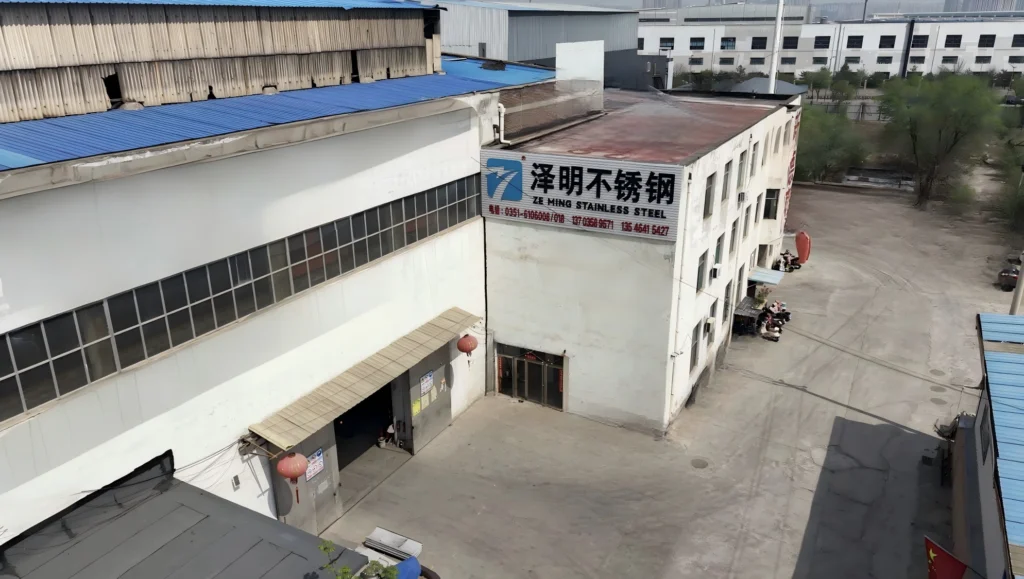
At ZEMSS, we operate five fiber laser cutting systems across a 12,000 m² facility in Taiyuan, China — ranging from 4 kW for precision thin-gauge work to a 60 kW machine capable of severing 50 mm stainless steel plate. This guide shares the data, tolerances, and cost levers we work with every day, so you can specify cutting requirements with confidence.
How Fiber Laser Cutting Works on Stainless Steel
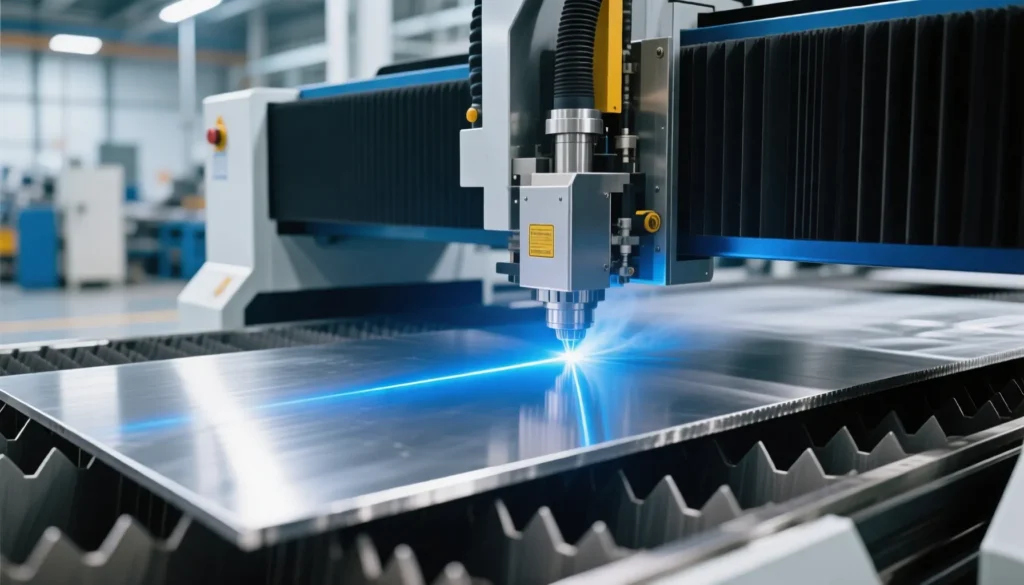
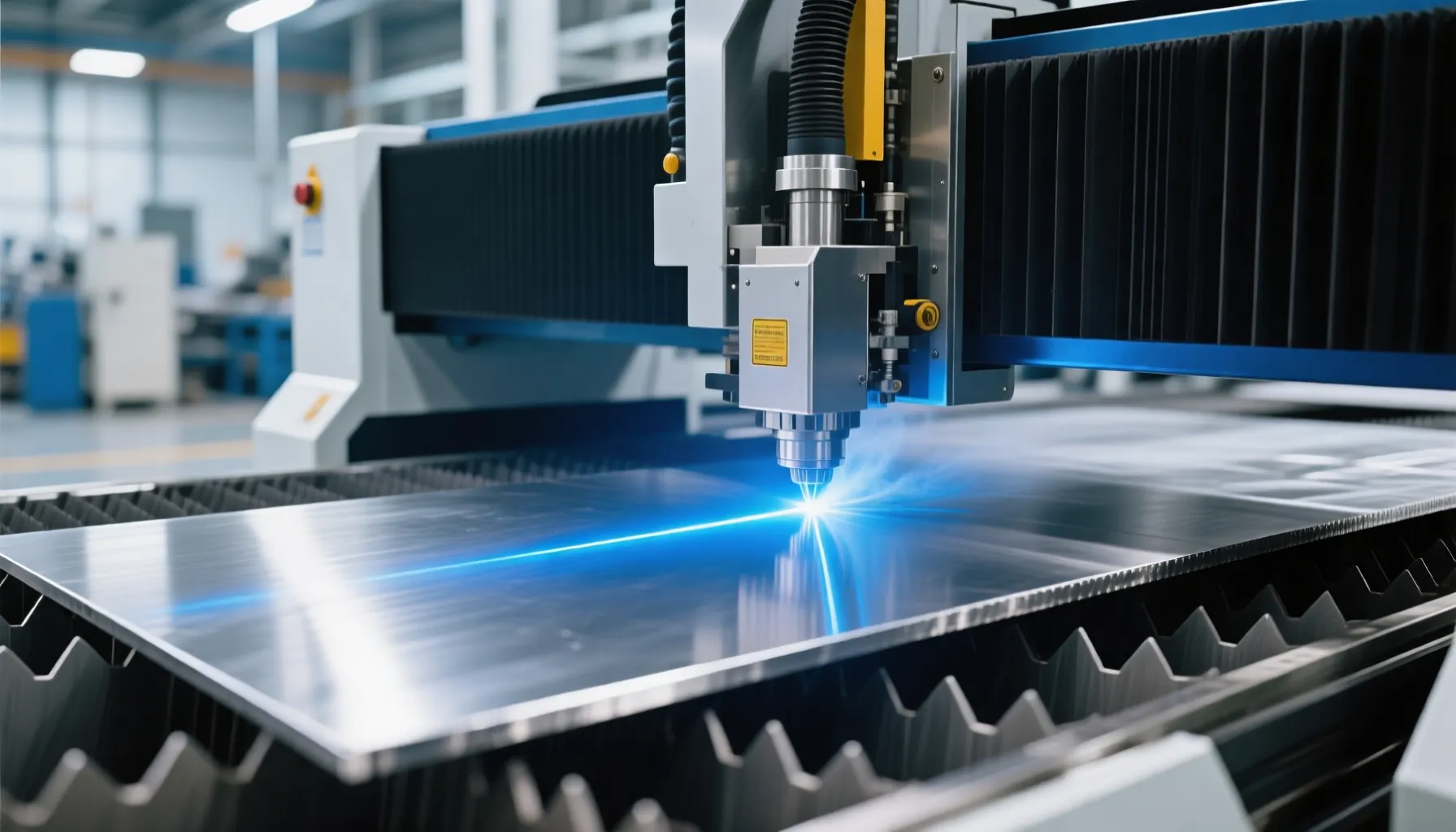
Fiber laser cutting is a thermal cutting process that uses a solid-state laser source amplified through doped optical fibers. The laser beam — typically at a wavelength of 1.06 µm — is delivered to the cutting head via a fiber-optic cable, where focusing optics concentrate the beam onto a spot as small as 50 µm in diameter. At that spot, the power density reaches approximately 10⁷ W/cm², instantly melting or vaporizing the stainless steel.
Why fiber wavelength matters for stainless
Stainless steel — particularly the austenitic grades 304 and 316L — reflects roughly 65-70% of a 10.6 µm CO₂ laser beam at room temperature. That means a CO₂ laser must overcome significant reflectivity before cutting begins, which wastes energy and creates an unstable start. Fiber lasers at 1.06 µm are absorbed approximately 3× more efficiently by stainless steel, so more of the power you are paying for goes into the cut. This is the single biggest reason fiber has displaced CO₂ across the stainless fabrication industry.
The role of assist gas
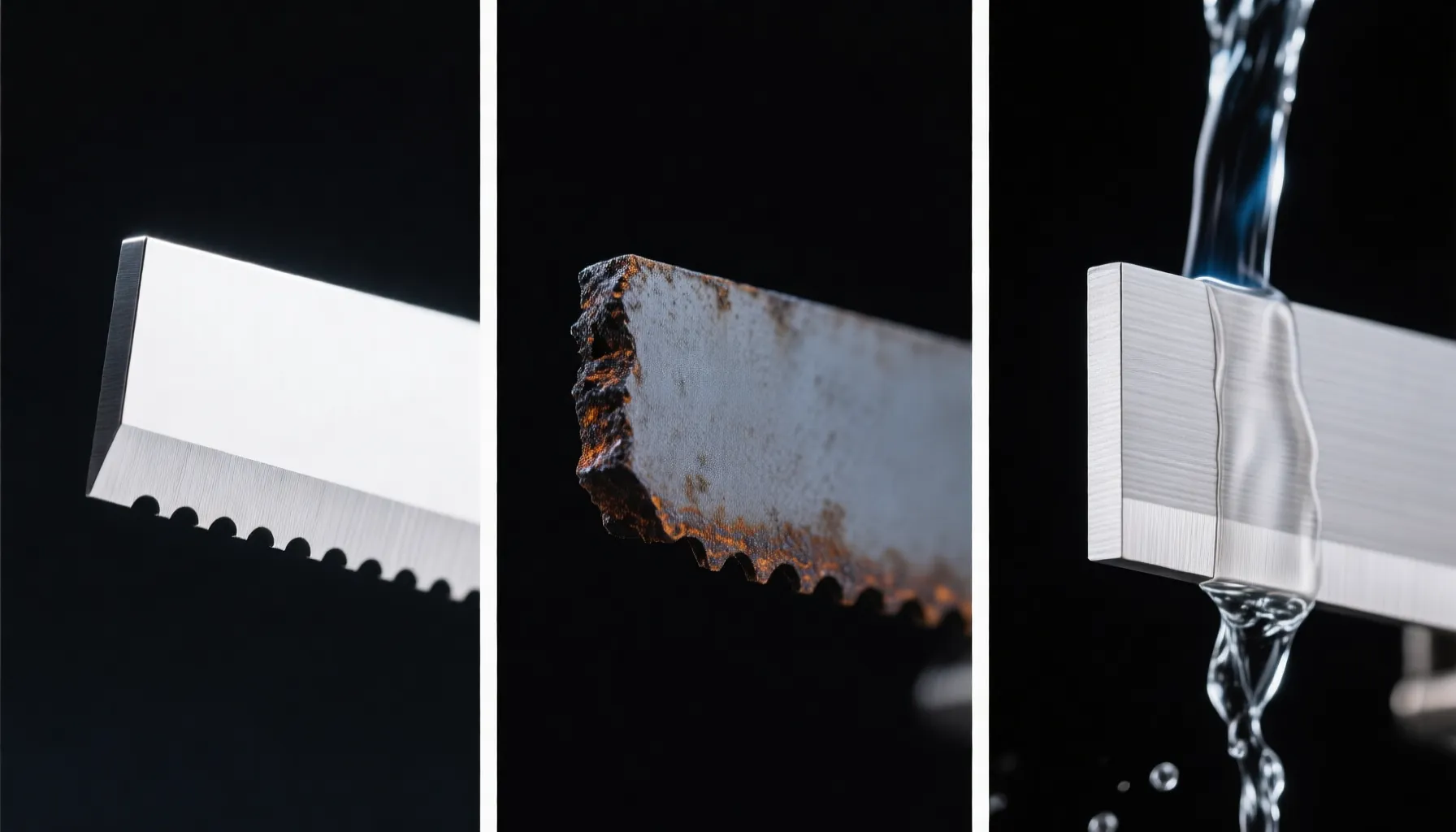
Assist gas is the high-pressure gas stream delivered coaxially with the laser beam through the cutting nozzle. It serves two functions: ejecting molten material from the kerf (the width of the cut slot) and controlling the chemical reaction at the cut face. For stainless steel, the choice is decisive:
| Gas | Purity Required | Edge Appearance | Best For | Thickness Limit |
|---|---|---|---|---|
| Nitrogen (N₂) | ≥ 99.95% | Bright, oxide-free, weld-ready | Food-grade vessels, architectural, medical | Up to 30 mm with 60 kW |
| Oxygen (O₂) | ≥ 99.5% | Dark oxidized edge, needs post-processing | Structural parts, weld-prep with grinding allowance | Up to 60 mm with 60 kW |
| Compressed air | Oil-free, dried | Light discoloration, acceptable after passivation | Cost-sensitive non-food applications | Up to 10 mm |
At ZEMSS we default to nitrogen for all stainless parts under 30 mm because it produces a weld-ready edge that requires zero secondary finishing — a cost your fabricator downstream will thank you for.
Kerf width and the heat-affected zone
The kerf width on a fiber laser cut in stainless steel typically ranges from 0.08 mm (thin sheet, small nozzle) to 1.5 mm (thick plate, large nozzle with oxygen). The heat-affected zone (HAZ) — the region adjacent to the cut where the metal’s microstructure changes due to thermal cycling — is narrow: typically 0.1–0.4 mm for nitrogen-cut stainless, versus 0.5–2.0 mm for plasma. A minimal HAZ preserves corrosion resistance and mechanical properties at the cut edge — a decisive advantage for stainless steel processing in chemical and marine environments.
Material Thickness Capability by Laser Power
Laser power and achievable cutting thickness are not a linear relationship. As plate thickness increases, the beam must penetrate deeper while the assist gas must eject a larger volume of molten material — and both physics and economics impose ceilings. The table below represents real production data from our factory floor, not idealised laboratory figures.
| Laser Power | 304 SS — N₂ Clean Cut | 304 SS — O₂ Max Sever | 316L SS — N₂ Clean Cut | 316L SS — O₂ Max Sever | 2205 Duplex — N₂ Clean Cut | Typical Kerf (N₂) |
|---|---|---|---|---|---|---|
| 4 kW | 5 mm | 8 mm | 4 mm | 6 mm | 4 mm | 0.10–0.20 mm |
| 6 kW | 8 mm | 12 mm | 6 mm | 10 mm | 6 mm | 0.15–0.30 mm |
| 12 kW | 16 mm | 25 mm | 14 mm | 22 mm | 12 mm | 0.25–0.50 mm |
| 20 kW | 25 mm | 40 mm | 22 mm | 35 mm | 20 mm | 0.35–0.70 mm |
| 30 kW | 35 mm | 55 mm | 30 mm | 50 mm | 28 mm | 0.50–1.00 mm |
| 60 kW | 50 mm | 80 mm | 45 mm | 70 mm | 40 mm | 0.80–1.50 mm |
Notes: “Clean cut” = nitrogen assist, oxide-free edge suitable for welding without post-processing. “Max sever” = oxygen assist, rougher edge requiring grinding/machining after cutting. All values assume optimal focus position, clean nozzle, and correct cutting speed. 316L typically runs 10–15% slower than 304 at equivalent thickness due to higher nickel content and lower thermal conductivity.
The jump from 30 kW to 60 kW is not just about doubling the thickness ceiling. At 60 kW, we can cut 20 mm 304 stainless at nearly 3× the linear speed of a 12 kW machine — which changes the economics dramatically for medium-thickness production runs. If your project involves stainless steel tanks or pressure vessels with plate thicknesses between 12 mm and 25 mm, the 60 kW machine delivers significantly lower per-part cost despite its higher hourly rate, simply because it finishes each sheet faster and consumes less gas per linear metre.
Tolerances and Precision in Fiber Laser Cutting
What ±0.1 mm actually means on the shop floor
A specification of ±0.1 mm on a laser-cut part is common, but it is not universal. When we quote ±0.1 mm at ZEMSS, that number applies to the laser positioning accuracy — the machine’s ability to place the beam where the CNC program commands. The finished part dimension is influenced by additional factors: kerf width compensation, thermal expansion during cutting, material flatness, and residual stress release. On a 300 mm-long part cut from 3 mm 304 sheet with nitrogen, a finished tolerance of ±0.15 mm is realistic and routinely achieved. On a 2,500 mm-long part cut from 20 mm plate with oxygen, expect ±0.5 mm to ±0.8 mm.
5 Things to Check When Specifying Laser Cutting Tolerances
- Material thickness vs. tolerance ratio. A ±0.1 mm callout on a 25 mm plate is physically different from ±0.1 mm on a 1.5 mm sheet. On thick plate, the kerf taper alone (wider at top, narrower at bottom) can consume half that tolerance band. Specify whether the dimension applies to the top face, bottom face, or mid-thickness.
- Is the tolerance applied to feature-to-feature or feature-to-edge? Internal cutout positions relative to each other are controlled by machine accuracy. Positions relative to the plate edge are also affected by sheet squaring and datum referencing — two different tolerance stacks.
- Surface condition of the incoming plate. Mill-scale, lamination, or residual stress in hot-rolled plate can cause the material to “walk” as internal stress is released during cutting. Stress-relieved plate or cold-rolled sheet gives tighter results.
- Are you cutting small holes? Holes with a diameter less than 1× material thickness require reduced cutting speed and a dwell/pierce sequence that affects local geometry. Below 0.8× thickness, consider drilling or punching instead — laser quality degrades.
- Post-cut operations. Will the part be pickled, passivated, or bead-blasted? These finishing steps remove 0.002–0.010 mm of material and can bring a borderline dimension into — or out of — specification.
Laser vs Plasma vs Waterjet — tolerances, cost, and speed
| Attribute | Fiber Laser (60 kW) | Plasma (HD, 300 A) | Waterjet (Abrasive, 60 000 psi) |
|---|---|---|---|
| Typical tolerance (thin, < 6 mm) | ±0.10 mm | ±0.50 mm | ±0.08 mm |
| Typical tolerance (thick, > 20 mm) | ±0.40–0.80 mm | ±1.50 mm | ±0.20 mm |
| Max SS cutting thickness | 50 mm clean / 80 mm sever | 50 mm (rough edge) | 200+ mm (any material) |
| HAZ width | 0.1–0.4 mm | 0.5–2.0 mm | None (cold process) |
| Edge quality (N₂ on SS) | Weld-ready, oxide-free | Bevel ~3°, heavy dross | Smooth, no thermal effect |
| Cutting speed (10 mm 304 SS) | ~2.8 m/min | ~1.2 m/min | ~0.08 m/min |
| Operating cost per metre (10 mm 304 SS) | ~$2.80 | ~$3.50 | ~$18.00 |
| Minimum hole diameter | ~0.8 × thickness | ~1.5 × thickness | ~1.0 × thickness (no HAZ) |
| Best application | Production parts ≤ 50 mm, tight tolerances, high volume | Structural parts, site work, loose tolerances | Thick plate, heat-sensitive alloys, no-HAZ requirement |
For the majority of stainless steel fabrication work — parts under 50 mm thick, quantities from one-off to thousands — fiber laser delivers the best balance of accuracy, speed, and cost. Waterjet remains the correct choice when zero HAZ is non-negotiable (e.g., certain nuclear or aerospace applications), and plasma serves structural work on construction sites where tolerances are loose. The international standard ISO 9013:2017 (Thermal cutting — Classification of thermal cuts — Geometrical product specification and quality tolerances) defines the formal tolerance classes we reference when a customer’s drawing calls out a specific ISO 9013 quality grade — typically Class 2 or Class 3 for our nitrogen-cut stainless parts (ISO 9013:2017).
Large Format Cutting — 3 m × 12 m Capability
A cutting bed measuring 3 metres wide by 12 metres long is not common in the laser cutting world. Most job shops run 1.5 m × 3 m or 2 m × 4 m tables. At ZEMSS, our 60 kW machine sits on a 3 m × 12 m bed, and the advantages for industrial fabrication are substantial.
Why large format matters
When you need a 10-metre-long sidewall for a rectangular tank, or a series of 2.4-metre-diameter flanges nested from a single plate, a large-format bed eliminates the need to splice smaller segments. Splicing requires welding, and welding introduces distortion, adds labour, and creates a potential leak path. A single-piece cut from a full-size plate is stronger, flatter, and faster to produce — even though the raw plate costs more per kilogram, the total fabricated cost is typically lower because you have removed an entire welding and grinding operation from the workflow.
Equally important for high-volume work: a 3 m × 12 m bed can be partitioned into zones. While the laser cuts in one zone, the operator loads the next plate in another — effectively eliminating idle time between sheets. This “dynamic table” capability keeps the machine cutting for a higher percentage of each shift, which translates directly to better pricing for our production-run customers.
For applications such as large-diameter stainless steel storage tanks, chemical processing vessels, and architectural cladding systems, the combination of 60 kW power and a 3 m × 12 m format means we can cut what other shops cannot — and at a tolerance they cannot match on thick-gauge material.
Cost Factors in Laser Cutting Stainless Steel
Understanding what drives the price of a laser-cut part helps you make design decisions that reduce cost without compromising function. Here are the dominant factors, in order of impact, based on our factory cost data for 304 and 316L stainless cutting.
1. Material thickness and cutting speed
Cutting speed drops non-linearly with thickness. While 1.5 mm 304 sheet can be cut at over 35 metres per minute with a 6 kW laser, 20 mm plate runs at approximately 0.8 metres per minute on the same machine. A part cut from 20 mm plate therefore consumes roughly 40× the machine time of the same profile in 1.5 mm sheet. Machine time is the single largest cost component for any laser cutting job.
2. Assist gas consumption
Nitrogen flow rates for thick-plate cutting can exceed 30 m³/h at pressures of 20–25 bar. At industrial bulk-gas pricing, nitrogen can account for 15–25% of the total cutting cost on parts thicker than 15 mm. Oxygen is less expensive per cubic metre but adds post-processing cost if the oxide layer must be removed before welding. We discuss this trade-off with every customer before quoting.
3. Nesting efficiency
The percentage of plate area that becomes sellable parts — typically 70–90% — directly determines material cost per part. Our CAD/CAM team uses Lantek and SigmaNEST software to optimise part placement, and for production quantities above 100 units, we can often push material utilisation above 85% by mixing parts from different jobs onto a single sheet. The difference between 70% and 85% utilisation on a 20 mm 304 plate is roughly $80–120 per sheet — savings we pass through to the customer.
4. Grade and inventory availability
304 and 316L in standard thicknesses (1.5 mm to 25 mm) are held in stock at our facility — over 1,000 tonnes across grades and gauges. When your design calls for 2205 duplex, 904L, or 254 SMO, material must often be sourced from mills with lead times of 2–6 weeks. Standard grades from inventory ship faster and cost less. Browse our stainless steel materials inventory for current stock levels.
5. Quantity and setup amortisation
Programming, nozzle setup, and first-article inspection are fixed costs per job — typically $80–$200 depending on complexity. On a single prototype part, that setup cost dominates the unit price. On 1,000 parts, it rounds to pennies. We recommend ordering at least 10–20 pieces per line item whenever project schedules allow, because the cost-per-part curve flattens dramatically after the first article.
6. Post-processing requirements
Deburring, pickling, passivation, surface finishing (2B, #4, BA), and dimensional inspection reports all add cost. Specify only what you genuinely need. If the part will be welded into an assembly that gets pickled as a unit, individual part passivation may be unnecessary — eliminating a $2–5 per-part cost step.
Quality Control for Laser-Cut Stainless Steel Parts
Our quality system operates to ISO 9001:2015 and is audited annually. For every laser-cut job, the following QC gates are mandatory — regardless of quantity or customer.
First Article Inspection (FAI)
Before production cutting begins, the first part off the laser is measured against all critical dimensions on the drawing using calibrated digital callipers, micrometres, and — for complex geometries — a coordinate measuring machine (CMM) or 3D scanner. Any deviation exceeding 50% of the specified tolerance triggers a parameter adjustment and a new FAI. We hold a complete FAI report on file for every job and provide it on request.
In-process verification
For quantities above 50 units, we pull a sample every 20 parts and verify three critical dimensions. This catches parameter drift — typically caused by nozzle wear, lens contamination, or assist-gas pressure fluctuation — before it produces non-conforming parts. On the 60 kW machine, nozzle condition is especially critical: a worn nozzle can widen kerf by 0.1–0.3 mm over the course of a single shift, so nozzles are inspected and replaced on a documented schedule.
Final dimensional inspection
A 100% check of all specified dimensions is performed on small-quantity jobs (≤ 20 parts). For larger runs, we follow ANSI/ASQ Z1.4 sampling plans at AQL 1.0 (normal inspection) unless the customer requires a tighter level. Material certificates (mill test reports) are matched to heat numbers and shipped with every order.
We have been manufacturing stainless steel products since 2005 — over 20 years — and our QC system is built on that experience. The procedures described here are not theoretical; they are the same ones our engineers follow every shift. For further reference on thermal cutting quality classification, see the ISO 9013:2017 standard, and for materials data on stainless steel grades in fabrication, the World Stainless Steel Association (worldstainless.org) maintains comprehensive technical resources.
Frequently Asked Questions
What is the maximum thickness a fiber laser can cut in stainless steel?
With a 60 kW fiber laser and nitrogen assist gas, we achieve clean, oxide-free cuts up to 50 mm in 304 and 45 mm in 316L. With oxygen assist (rougher edge requiring post-processing), 304 can be severed up to 80 mm. For most industrial applications requiring a weld-ready edge, 30–40 mm is the practical production ceiling. Always match laser power to your thickness requirement — a 12 kW machine cuts 16 mm 304 cleanly and below that the cost-per-metre is excellent, but above 16 mm you need 20 kW or higher for economic production speeds.
How do fiber laser tolerances compare to waterjet cutting for stainless steel?
Waterjet cutting achieves slightly tighter tolerances on thick plate (±0.20 mm vs ±0.40–0.80 mm for laser above 20 mm) and produces zero heat-affected zone, making it preferable for heat-sensitive alloys or applications with strict no-HAZ requirements. However, waterjet is 5–10× slower than laser on stainless steel and costs roughly 6–8× more per linear metre. For 90%+ of stainless fabrication work — parts under 40 mm thick with standard tolerance requirements — fiber laser delivers the optimal balance. The 60 kW fiber laser has narrowed the gap significantly: at 20–30 mm, the tolerance differential versus waterjet is now under 0.3 mm in most cases.
Can you laser-cut 316L to the same quality as 304 stainless steel?
Yes, but with caveats. 316L has a higher nickel content and lower thermal conductivity than 304, which means it requires approximately 10–15% slower cutting speeds at equivalent thickness and power. Edge quality with nitrogen is comparable — bright, oxide-free, and weld-ready — but parameter tuning is different. Our machines store dedicated cutting tables for 304, 316L, 2205, and other grades, each developed and verified on our factory floor over hundreds of production hours. We do not use a “one-size-fits-all” parameter set; the differences are real and measurable.
What information do I need to provide for an accurate laser cutting quote?
To quote precisely we need: (1) material grade and thickness, (2) DXF or DWG file showing part geometry with all dimensions, (3) quantity required, (4) tolerance specification (include which standard — ISO 2768, ISO 9013, or your own drawing tolerances), (5) surface finish requirement (2B, #4, BA, etc.), and (6) any post-processing needed (deburring, pickling, passivation, inspection reports). With these six pieces of information, we can typically return a firm quotation within 4 business hours for standard grades and thicknesses. Send your drawings to our engineering team through the contact form and we will respond same-day.
Partner with a Manufacturer That Cuts Stainless Steel Every Day
Fiber laser cutting technology has matured to the point where the limiting factor is no longer the machine — it is the expertise of the team running it. At ZEMSS, stainless steel laser cutting service China is not a sideline; it is what our factory was built to do. Five laser systems. A 60 kW, 3 m × 12 m flagship machine. Over 20 years of stainless steel fabrication experience. ISO 9001:2015 certified quality management. More than 1,000 tonnes of stainless steel plate and sheet in inventory.
We are the manufacturer, not a middleman. When you send us a drawing, our engineers programme the laser, cut the first article, measure it, and ship the parts — all under one roof. No subcontracting. No finger-pointing. Just parts that meet your specification.
Ready to get a quote? Send your DXF/DWG files and specifications to our engineering team. We respond within one business day with a firm price and lead time. Visit our processing capabilities page for full machine specifications and capacity, or browse our materials inventory to confirm stock availability.