

Stainless steel fabrication cost per kg is meaningful only when the process scope and the weight basis are defined. Two quotes for the same grade can include different cutting, bending, welding, finishing, inspection and packing work. Comparing their headline rates alone can give the wrong answer.
This guide shows how to build a comparable quotation request, separate one-time work from repeat production and identify the drawing details that change the cost. It does not present a generic market rate as a factory quote: a usable price needs the current drawing, quantity and supply requirements.
What makes up a stainless steel fabrication price?
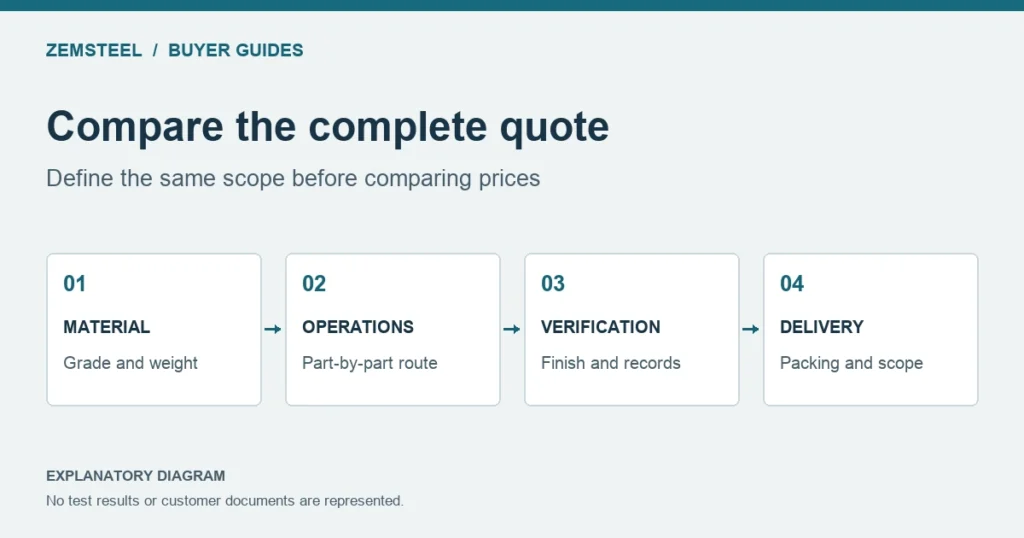
For comparison, break the quoted scope into material, preparation and setup, production operations, finishing, inspection and documentation, and packing or delivery items. The supplier may combine some of these commercially, but the inclusions and exclusions should remain clear.
A practical quotation worksheet can use:
Order total = quoted one-time charges + quantity-based production charges + separately quoted services and delivery items.
This is a comparison structure, not a universal pricing model. Do not add a separate material allowance if material is already included in a unit price, or add a finishing estimate to a quote that already includes it.
- Material: grade, product form, thickness or section, condition and required certification.
- Preparation: drawing review, programming, nesting, fixtures and any agreed prototype work.
- Production: cutting, bending, tapping, machining, fitting, welding and deburring as applicable.
- Finishing: defined surfaces, weld dressing, blasting, polishing or chemical treatment.
- Verification: inspection coverage, test methods, witness points and document package.
- Delivery scope: protection, crates, agreed transport services and the named delivery term and place.
Cost per kg: agree what the kilograms represent
Ask whether the rate applies to purchased stock, calculated blank weight, finished net part weight or another agreed invoicing basis. These quantities can differ substantially for parts with cutouts, trim allowances or machining.
For your own comparison, divide the same included cost total by the same weight definition for every supplier. A quote based on purchased sheet weight cannot be compared directly with another based on finished part weight. Packing weight should also be distinguished from the net weight of the parts.
Ask how offcuts, reusable remnants and scrap are handled in the quote. Clarify whether minimum material purchases or customer-specific stock are included. Do not assume that every unused piece receives a scrap credit or that every remnant can be reused in the next order.
A per-piece price is often clearer for assemblies with substantially different operations. Keep a per-kg comparison as a secondary measure if it helps procurement, while preserving the actual part quantities and operations behind it.
Separate part families by their manufacturing route
A common quotation problem is to group all stainless components under one rate even though only some require additional operations. The following purchasing example separates the scope without attaching unverified market prices:
Plate parts with cutting and bending
Define the material, cut geometry, thickness, bend details, deburring, finish and packing. Identify whether the supplier must develop the flat pattern or receives an approved one. Agree which drawing controls if the supplied flat pattern conflicts with the formed model.
Plate parts with additional tapping or hardware
Identify the affected part numbers, thread sizes and depths, hole quantities, inserts or other hardware, and required checks. Do not spread a tapping allowance across every part if only selected parts need threads. Include thread-edge deburring and any masking or cleaning needed during finishing.
Tube parts with laser cutting
Specify the section, length, cut features, end condition and finish. List bending only if the tube actually requires it. Plate-bending work should not silently become an inclusion in the tube quote simply because both appear in the same RFQ.
This separation reflects the type of scope clarification encountered in fabrication enquiries. It is a generalized quotation example, not a published customer order or a record of achieved production costs.
How each process changes the quotation
Material grade and stock form
Request the specified grade in the actual product form and dimensions needed. State whether alternatives may be proposed separately. A lower-priced substitution should not be hidden inside a nominally comparable quote.
Availability, minimum purchase quantities and document requirements belong in the supplier’s current offer. Material prices change, so record the currency, quote date and validity instead of treating an old online price as the purchasing basis.
Laser cutting and edge preparation
Weight alone does not describe cutting work. Supply the profile and internal features so the supplier can assess cutting paths, piercings, handling and nesting. Identify burr limits, edge preparation and critical holes. If further machining is needed after cutting, specify the allowance and which dimensions are accepted at which stage.
Bending and forming
Show material thickness, bend radii, angles, flange dimensions and the critical formed dimensions. Tool access and bend sequence can affect feasibility as well as cost. Large or awkward parts may need handling provisions that are not captured by simply counting bends.
If the fabricator suggests a different radius or relief to suit available tooling, review and approve the drawing change before production. Design-for-manufacture guidance from Xometry also identifies material choices, bend geometry and finishing decisions as cost considerations; those suggestions still need to meet the part’s functional requirements.
Fitting, welding and distortion control
Identify joint locations, required welds, access and inspection. A quote for an externally accessible bracket is not comparable with one for an assembly requiring internal welding, fixtures and controlled dimensions after welding.
State whether welds remain visible, are blended or are dressed to an approved profile. Add any examination requirements. A low welding allowance can be misleading if fit-up, post-weld correction or finishing has simply been excluded.
Tolerances and inspection
Mark functional dimensions and interfaces clearly. Avoid assigning unusually tight requirements to every feature by default, but do not relax a functional tolerance merely to obtain a lower quote. Ask the supplier to identify the features driving extra work and submit alternatives for approval.
Specify first-article inspection, sampling or full inspection where required. Different inspection coverage can change the scope even when the physical parts appear identical. A generic “quality included” line does not define the records the buyer will receive.
Finishing and documentation need their own scope
State which surfaces require brushing, bead blasting, polishing, pickling, passivation or another treatment. Separate cosmetic requirements from measured roughness and treatment verification. A named finish on one visible face is a different task from a finish required on all internal welds and contact surfaces.
Ask whether subcontracted treatment, handling and transport between operations are included. Do not assume that a quoted process is performed in-house. Our surface finishing guide explains how to define finish zones and acceptance.
Material certificates, part traceability, PMI, weld examination and leak testing are also different deliverables. State which apply and when they must be reviewed. See how to verify an MTR for a document checklist. Do not add testing solely because it appears in a generic checklist; tie it to the design and order requirements.
Prototype, repeat order and annual forecast
Separate prototype pricing from the price for a defined production batch. The first order may include programming, fixtures, sample approval and extra inspection. Ask which charges are one-time, which can be reused and what changes would trigger them again.
A larger quantity can spread setup work across more parts, but there is no universal discount percentage. Part mix, material utilization, treatment batches, inspection and delivery schedule all matter. Ask for price breaks against specific quantities and the same drawing revision.
An annual forecast is not the same as a committed release quantity. If a buyer expects repeated orders but will initially purchase only a trial batch, request both scenarios explicitly. State whether the supplier is being asked to hold stock, retain tooling or reserve capacity, and include any commercial conditions in the offer.
How to compare two fabrication quotes
- Match the technical baseline: drawing revision, material, part numbers, quantities and approved deviations.
- Match the operations: include deburring, tapping, weld finishing and other secondary work.
- Match inspection and documents: compare actual coverage and deliverables.
- Match the price basis: currency, units, weight definition, setup charges and quote validity.
- Match delivery scope: named delivery term and place, protection, packing and included transport.
- Record exclusions and assumptions: resolve them before treating the totals as equivalent.
For each unanswered point, mark “not confirmed” rather than treating the missing item as included at zero cost. Ask for a revised offer after clarifications so procurement, engineering and the supplier work from the same scope.
Common gaps include an unspecified finish on internal surfaces, inspection quoted only as an optional extra, packing without suitable surface protection and a price based on a forecast quantity rather than the quantity ordered.
Prepare an RFQ that supports a useful price
Provide the current 2D drawing and, where available, the 3D model or cutting file. The drawing should identify requirements that geometry alone does not communicate, such as weld instructions, finish zones, hardware and inspection notes. Protolabs’ sheet-metal quoting guidance likewise explains the role of drawings alongside model data.
- Part list, drawing numbers and revisions, quantities per part and required delivery schedule.
- Material grade, standard, thickness or section and whether alternatives are permitted.
- Critical dimensions, interfaces, threads, weld requirements and approved finish specification.
- Required inspection, certification, traceability and any buyer witness points.
- Packing requirements, delivery destination and requested quotation basis.
- Separate prototype, batch and forecast quantities, with any drawing changes still under review.
If files require a confidentiality agreement, arrange that before sending restricted drawings. A preliminary description can establish the proposed scope, but a firm manufacturing quotation should follow review of the necessary technical information.
Request a stainless steel fabrication quote from ZEMSTEEL. Include the process groups you want priced separately and ask for assumptions, exclusions and document requirements to be stated in the offer.