
304 vs 321 Stainless Steel: When Titanium Stabilization Is Worth Paying For
The short answer: 321 is 304 plus titanium, and the only job that titanium does is protect the material at high temperature and in as-welded service. At room temperature, the two grades are nearly identical in corrosion resistance, strength, and formability. If your part operates below about 425°C (800°F), 321 buys you almost nothing except a higher invoice. If it runs hot — exhaust systems, boilers, heat exchangers, furnace components — or it is welded and can never be annealed afterwards, 321 (or a modern low-carbon alternative) is the right call.
This guide explains what “stabilized” actually means, compares the chemistry, high-temperature behaviour, weldability, and cost of 304 vs 321 stainless steel, and gives you a practical framework for choosing. If you are weighing other austenitic grades, see our 304 vs 316L comparison and 304L vs 316L guide.
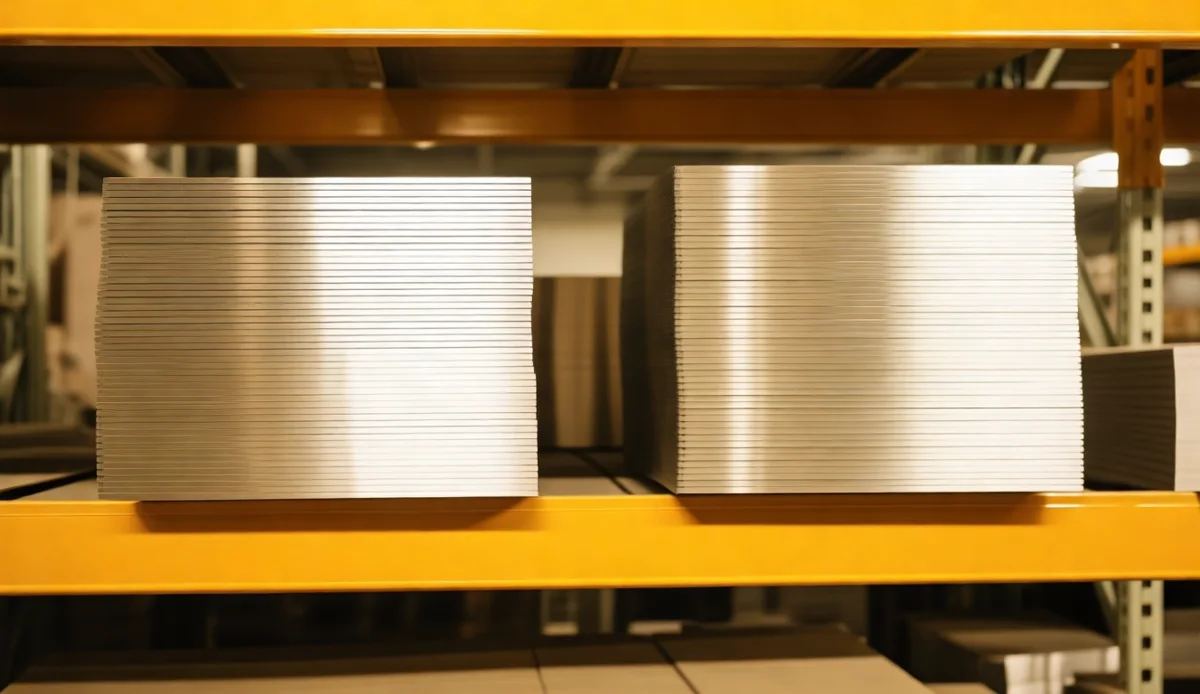
What 321 Actually Is: 304 Stabilized with Titanium
To understand the comparison you need one piece of metallurgy. All austenitic stainless steels contain a little carbon. When they are held in the temperature range of roughly 425–850°C — which happens unavoidably in the heat-affected zone next to any weld — carbon combines with chromium to form chromium carbides at the grain boundaries. That strips chromium from the surrounding metal, breaking the passive film locally. The result is sensitization: a weld zone that can corrode intergranularly, sometimes crumbling along the weld line in aggressive service.
321 (UNS S32100, EN 1.4541) solves this by adding titanium. Titanium is a stronger carbide former than chromium, so it grabs the carbon first, forming stable titanium carbides. The chromium stays in solution, the passive film stays intact, and the material can be welded and held at temperature without becoming sensitization-prone. The rule in the standard is a titanium addition of at least five times the carbon content (minimum ~0.15% in practice, capped at 0.70%).
That single addition is the entire difference between the grades. Everything else below follows from it.
Chemical Composition Compared
The table below shows why the 304 vs 321 comparison comes down to one row.
| Element | 304 (UNS S30400) | 321 (UNS S32100) | Why it matters |
|---|---|---|---|
| Carbon (C) | 0.08% max | 0.08% max | Same carbon level — the difference is what ties it up |
| Chromium (Cr) | 18.0–20.0% | 17.0–19.0% | Base corrosion resistance; nearly identical |
| Nickel (Ni) | 8.0–10.5% | 9.0–12.0% | 321 runs slightly higher nickel |
| Titanium (Ti) | — | ≥ 5×C, 0.70% max | The whole story — stabilization against sensitization |
| Manganese (Mn) | 2.0% max | 2.0% max | Standard austenite support |
Chromium and nickel — the elements that actually resist corrosion — are essentially the same in both grades. That is why their room-temperature behaviour is so similar. The titanium in 321 does not make it “more stainless”; it makes it thermally safer.
Corrosion Resistance at Room Temperature: Effectively a Tie
This surprises buyers who assume the pricier grade must corrode better. At ambient temperatures, 304 and 321 are interchangeable for almost every corrosion question. Both resist atmospheric exposure, fresh water, food acids, and most mild chemicals; both pit in sustained chloride exposure (sea water, de-icing salts, chloride cleaners); both have a PREN in the 18–20 range.
The one corrosion scenario where 321 wins at low temperature is specific: an as-welded part in a mildly corrosive environment, where 304’s weld zone could be sensitized and 321’s cannot. But note the modern answer to that problem is usually a low-carbon grade (304L), not 321 — more on that below. For ordinary corrosive service, if you need more resistance than 304 gives, the move is up to 316L or a duplex grade, not up to 321.
High-Temperature Service: The One Job 321 Was Built For
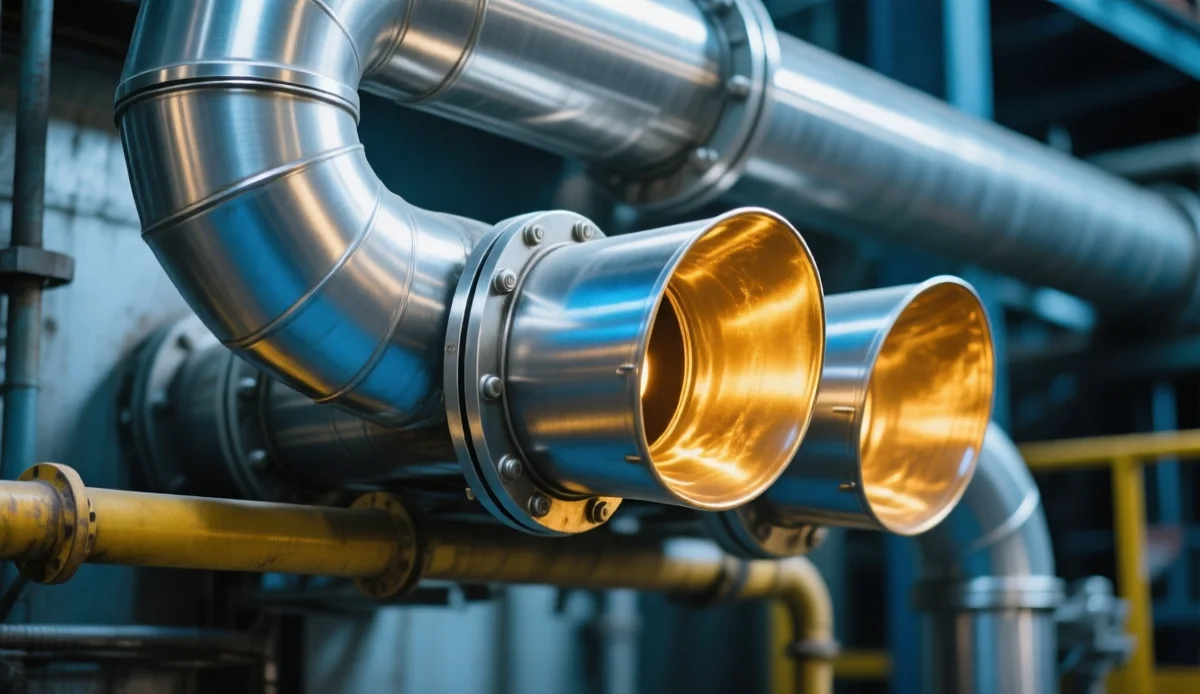
This is where the grades part ways. Above roughly 425°C, plain 304 used in welded condition begins to suffer the sensitization problem continuously, and its creep strength (resistance to slowly deforming under load at temperature) is modest. 321 performs better on both counts:
- Stabilization holds at temperature. Because the carbon is locked up as titanium carbide, 321 can live continuously in the sensitization range (425–850°C) without intergranular corrosion risk. This is exactly the operating window of exhausts, boilers, and heat treating equipment.
- Better creep strength. The fine titanium carbides also strengthen the matrix at temperature, so 321 carries load longer before creeping. Codes such as ASME allow higher allowable stresses for 321 than 304 at elevated temperature, which can let you use thinner sections.
- Oxidation resistance of the two grades is similar — both resist scaling up to roughly 870°C in continuous service — so the deciding factor is not oxidation but strength and stabilization.
Typical 321 territory: aircraft and automotive exhaust components, manifolds and heat shields, boiler and superheater parts, heat exchanger components in hot service, expansion joints and bellows, furnace fixtures, and afterburner components. If your specification mentions continuous service anywhere in the 425–870°C band and welding is involved, 321 (or niobium-stabilized 347) is usually the grade on the drawing — and for good reason.
Welding 321: The Counterintuitive Part
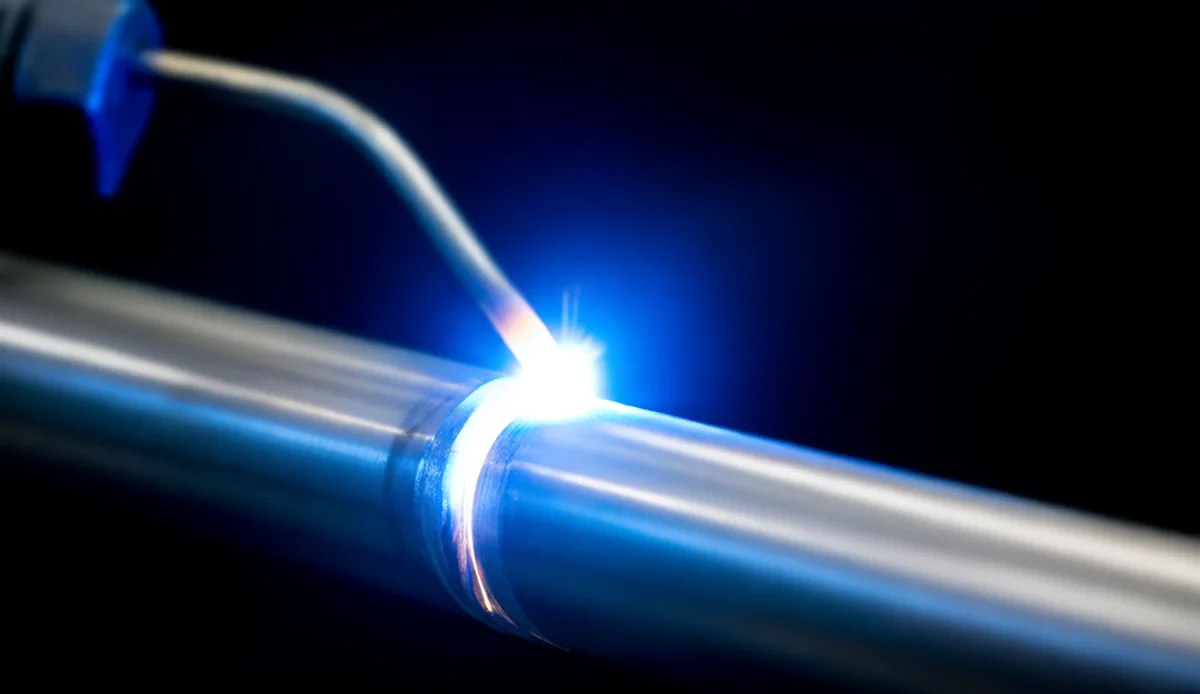
Here is the detail that separates experienced fabricators from everyone else. 321’s titanium is its virtue in the base metal — but titanium does not transfer well across a weld arc. It oxidizes and is lost from the weld pool, so the weld metal itself is essentially unstabilized, even when you weld 321 plate.
The practical consequences:
- For critical welds on 321, the standard practice is a niobium-stabilized filler such as 347/ER347. Niobium does the same stabilization job as titanium but survives the welding process, so the weld metal is stabilized too.
- For non-critical joints, 308/308L fillers are sometimes used, but the weld zone will not have stabilization — acceptable where the joint will not see the sensitization temperature range in corrosive service.
- 321 base metal itself welds readily with common processes (TIG, MIG, resistance) and does not need preheat. Post-weld annealing is not required — that is the whole point of a stabilized grade. (More on welding process choice in our stainless welding process guide.)
If you are sourcing welded 321 assemblies, ask the fabricator which filler they will use. An answer of “347 or equivalent” signals someone who has done this before.
The Modern Alternative: Why 304L Has Eaten 321’s Lunch
There is a reason 321 is less common than it used to be. The original problem — weld sensitization of 304 — can also be solved by simply lowering carbon to 0.03% max, producing 304L. Low-carbon grades avoid carbide formation because there is almost no carbon to form them.
For service below about 425°C, 304L delivers the same as-welded safety as 321, and it is cheaper, more widely stocked, and easier to weld (no filler-transfer complications — 308L works perfectly). So the modern selection rule is:
- Welded structure, low or moderate temperature → 304L (or 316L if chlorides are present). Not 321.
- Continuous high-temperature service, 425–870°C → 321 (or 347). Here low carbon is not enough: you need stabilization that survives long-term exposure, plus the creep strength titanium carbides provide.
This is the decision that saves buyers money most often: specifying 321 for a room-temperature welded tank or frame is paying a premium for protection you will never use, when 304L would do the same job for less.
Mechanical Properties and Fabrication
Ambient-temperature mechanical properties of the two grades are very close — same strength class, same excellent ductility, same non-magnetic austenitic behaviour when annealed. Two fabrication notes:
- Machining: 321 is slightly less pleasant to machine. The titanium carbides are hard particles that increase tool wear, and 321’s chips are a little more abrasive. For high-volume machining, budget tooling accordingly; for one-off parts the difference is minor.
- Forming: both grades deep-draw and bend well. 321 may need marginally more force in heavily cold-worked conditions but nothing that changes process choice.
| Property | 304 | 321 |
|---|---|---|
| Yield strength (annealed) | ~205 MPa | ~205 MPa |
| Tensile strength | ~515 MPa | ~515 MPa |
| Creep strength at 650°C | Moderate | Noticeably higher |
| Max continuous service temp | ~870°C (with sensitization risk if welded) | ~870–900°C (stabilized) |
| Machinability | Better | Slightly worse (Ti carbides) |
Cost and Availability: The Real Premium
321 costs more than 304, for two reasons. Titanium alloying and the smaller production volumes add a premium — typically in the range of 10–20% over 304 depending on product form and market conditions. And availability is thinner: 304 is the most stocked stainless on earth in every form, while 321 is commonly held in plate, bar, pipe, and tube but can be slow or made-to-order in thin sheet, small diameters, and fittings.
A quick worked example. Say a heat-treatment basket order needs 800 kg of plate. If 321 carries a 15% premium over 304, the extra material cost is meaningful but small relative to the basket’s service life — and because the basket lives at 700°C, choosing 304 would mean weld-zone corrosion and early failure, costing far more in replacements and downtime. Clear win for 321. Now take a welded indoor handrail of the same weight: the 321 premium buys no benefit at all, because the part never sees sensitization temperatures in service. 304L (or plain 304) does the identical job for less. Rule: pay for stabilization only where temperature will use it.
Industry-by-Industry Selection Guide
| Application | Recommended | Why |
|---|---|---|
| General architectural / structural | 304 | No high temperature; 321 adds nothing |
| Food & beverage equipment | 304 / 304L | Hygienic welding covered by low carbon; no need for Ti |
| Chemical process vessels (ambient) | 304L / 316L | Low carbon protects welds; Mo grades fight chlorides |
| Exhaust systems, manifolds, heat shields | 321 | Continuous hot gas exposure, welded, cyclic heating |
| Boiler & heat exchanger hot sections | 321 / 347 | Creep strength + stabilization at 425–870°C |
| Furnace fixtures, heat-treat baskets | 321 (310s for higher temps) | Repeated thermal cycling without sensitization |
| Expansion joints & bellows in hot lines | 321 | Thin formed + welded sections living at temperature |
| Pressure vessels at elevated temp | 321 / 347 | Higher code allowable stresses; see our pressure vessel standards guide |
Common Misconceptions About 321
“321 is more corrosion-resistant than 304.” Not at normal temperatures. Same chromium, same nickel, same PREN. The titanium only protects against weld-zone sensitization at elevated temperature. If a supplier quotes 321 “because it’s better against corrosion,” ask questions.
“321 welds are automatically safe.” The base metal is stabilized, but the weld metal loses titanium across the arc. Critical welds need 347-type filler to be truly stabilized. This is one of the most commonly missed details in fabricated 321 assemblies.
“If the drawing says 321, I can substitute 304L.” Only below about 425°C. In continuous high-temperature service, low carbon alone does not provide the long-term stabilization and creep strength that titanium does. Substituting the wrong way — 304 for 321 in hot service — causes weld-zone cracking and corrosion; substituting 321 for 304L in cold service just wastes money. Direction matters.
“Titanium makes it lighter or exotic.” The titanium content is under 0.7% — it is a microalloying addition, not a titanium alloy. Density, modulus, and fabrication behaviour remain standard austenitic stainless.
How to Verify You Actually Got 321
Because 321 carries a premium, substitution risk is real — and here is the good news: titanium is easy to detect. A portable XRF/PMI analyser shows the Ti peak within seconds, instantly distinguishing 321 from 304 (which has none). Our MTR verification guide walks through checking the mill certificate the same way.
For any 321 order, request the mill test certificate and confirm two numbers: titanium content meeting ≥ 5×C, and carbon at or below 0.08%. If the project is hot-service and critical, a PMI spot check on delivery takes thirty seconds and removes all doubt. We supply 321 material with full mill certification.
Frequently Asked Questions
The questions buyers and engineers ask most about 304 vs 321 stainless steel, answered directly.
What is the main difference between 304 and 321 stainless steel?
321 is 304 with a titanium addition (minimum five times the carbon content). The titanium stabilizes the steel against sensitization — chromium carbide precipitation at 425–850°C — making 321 suitable for welded parts in continuous high-temperature service. Below about 425°C the two grades behave almost identically.
Can I use 304 instead of 321?
Only if the part never operates above roughly 425°C and weld sensitization is not a concern. In hot exhaust, boiler, or furnace service, substituting 304 for 321 risks weld-zone corrosion and creep failure. In ambient-temperature service, 304 (or better, 304L) is fine and cheaper.
Is 321 stainless steel better than 304 for high-temperature use?
Yes — that is its purpose. 321 retains stabilization and higher creep strength through continuous service at roughly 425–870°C, where plain 304 (especially when welded) would sensitize and weaken. For even higher temperatures, consider 310S.
Is 321 more corrosion-resistant than 304 at room temperature?
No. The two grades have essentially the same chromium and nickel content and the same general corrosion resistance. 321’s advantage is specifically resistance to intergranular (weld-zone) corrosion after exposure to sensitization temperatures.
What filler should I use when welding 321?
Use a niobium-stabilized filler such as ER347 for critical welds. Titanium is lost across the weld arc, so the weld metal itself would be unstabilized; 347 filler restores stabilization in the weld. For non-critical joints, 308/308L is sometimes used, but the weld zone will lack stabilization.
Why would I choose 304L instead of 321?
For welded parts operating below about 425°C, 304L provides the same weld-zone safety at lower cost and with better availability. Choose 321 only when the part will live at elevated temperature, where low carbon alone is not sufficient.
What is 321 stainless steel commonly used for?
Aircraft and automotive exhaust components, manifolds and heat shields, boiler and heat exchanger parts in hot service, expansion joints and bellows, furnace fixtures, heat-treatment baskets, and pressure vessels operating at elevated temperature.
How can I verify material is really 321?
Check the mill test certificate for titanium ≥ 5× carbon, and confirm with a portable XRF/PMI check — titanium shows up clearly and distinguishes 321 from 304 in seconds. Given the price premium, verification is worth the effort.
Conclusion: One Question Decides It
Will the part live above about 425°C in service — especially welded? If yes, 321 (or 347) is worth every cent: it is the titanium stabilization and creep strength you are buying. If no, stop paying for titanium — 304 for simple service, 304L for welded structures, and 316L where chlorides are involved. The failure mode to avoid is not dramatic; it is a weld zone that slowly corrodes or a hot component that creeps out of shape, both quietly expensive. Match the grade to the temperature, verify the material certificate, and the 304 vs 321 decision takes care of itself. If you want a recommendation tied to your exact service temperature and welding plan, contact us with the details and we will answer with the right grade and full certification.
References: ASTM A240 / A240M — Standard Specification for Chromium and Chromium-Nickel Stainless Steel Plate, Sheet, and Strip (ASTM). 1 Nickel Institute / BSSA — guidance on stabilized grades and high-temperature service (nickelinstitute.org). 2 AWS A5.9 — Specification for Bare Stainless Steel Welding Electrodes and Rods, filler selection (AWS). 3