
By Chen Ming, Senior Fabrication Engineer · Updated September 4, 2026 · 9 min read
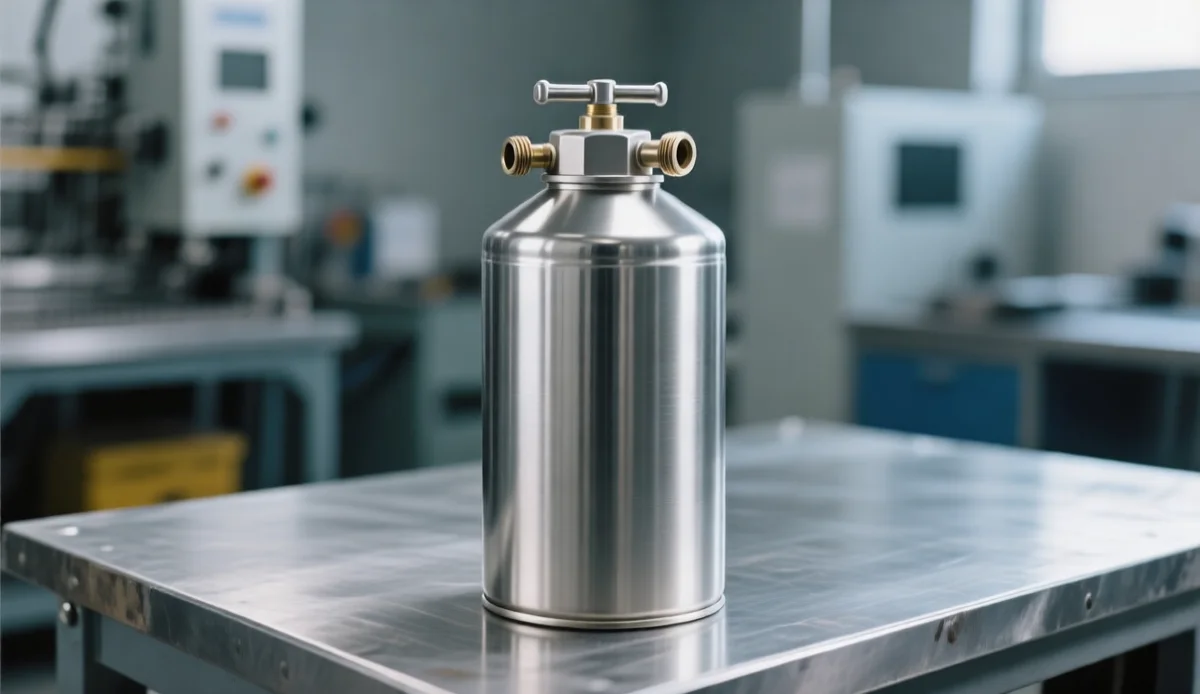
Metal powder is the most expensive consumable in a metal AM shop — titanium alloy powder can run $300–600 per kilogram — and it is also the most fragile. Moisture raises oxygen pickup; oxygen pickup embrittles titanium parts; cross-contamination between alloys scraps entire batches. The container that powder lives in between atomization, sieving, storage and the printer hopper is therefore not packaging. It is process equipment.
This guide covers what a proper stainless steel powder canister must do, how to specify one, and which standards now apply — including the 2024 Chinese national standard that many export shipments are now checked against.
1. What Powder Storage Actually Has to Protect Against
Four failure modes drive every design decision below:
| Threat | Consequence | Countermeasure |
|---|---|---|
| Moisture ingress | Hydration, oxygen pickup, poor flow, porosity in parts | Hermetic seal + argon purge + desiccant option |
| Oxygen exposure | Embrittlement (severe for Ti alloys), changed laser absorption | Inert gas blanketing, oxygen indicator option |
| Cross-contamination | Alloy mix-up, scrapped batches, failed certifications | One canister per alloy, electropolished interior, full discharge |
| Static discharge | Ignition risk with reactive powders (Al, Ti fines) | Grounding lug, bonded valve, NFPA 484 handling rules |
Aluminum and titanium powders additionally fall under combustible-metal handling rules (NFPA 484 in the US); the container itself is part of that control chain, which is why grounding points are a normal line item, not an option.
2. Material: Why 316L Is the Default
Austenitic stainless is standard for powder contact surfaces. The choice is usually between 304 and 316L:
| Factor | 304 | 316L |
|---|---|---|
| Corrosion resistance | Good in dry service | Superior; tolerates humid storage and washdowns |
| Surface finish achievable | 2B / brushed typical | Electropolish to Ra ≤ 0.8 µm routine |
| Low-carbon weldability | Adequate | Better for repeated weld repair of fittings |
| Cost premium | Baseline | ≈ +15–25% |
| Verdict | Acceptable for inert, dry powders with fast turnover | Default for Ti/Ni/Al powders and long storage |
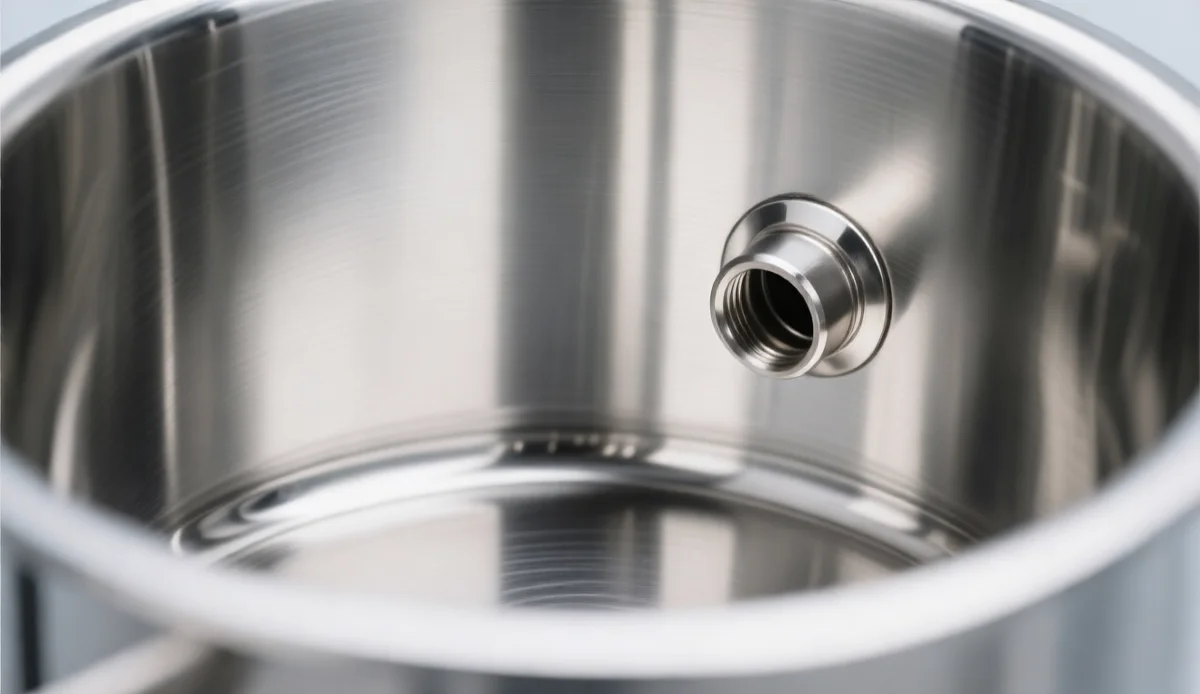
For the full grade trade-off, see our 304 vs 316L comparison. The interior finish matters more than the grade: a rough surface traps particles in microscopic pits and defeats alloy changeover cleaning. Electropolishing to Ra ≤ 0.8 µm (measured per ISO 4287) is the normal spec — Ra value ranges are covered in our surface finishing guide — with a mill certificate plus a finish measurement report shipped together (EN 10204 3.1 type documentation).
3. Six Features That Separate a Real Canister from a Bucket with a Lid
3.1 Seal and lid
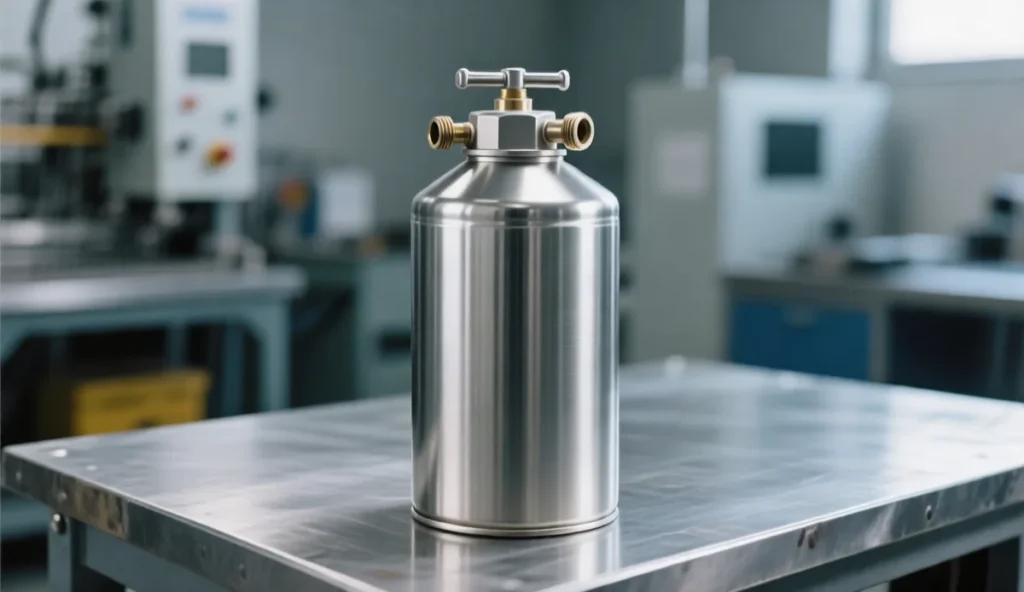
Tri-clamp style lids with a PTFE envelope gasket give tool-free opening and reliable resealing; bolted flange lids with metal-to-metal contact plus an O-ring groove suit long-term storage. Silicone gaskets should be avoided for fine metal powders — they off-gas and absorb moisture.
3.2 Argon purge port
A 1/4″ or 6 mm port with a needle-valve fitting lets the operator evacuate air and backfill argon before sealing. For titanium powders, shops typically purge to below 1% O₂ measured at the port.
3.3 Discharge without dust
A bottom butterfly or pinch valve with a grounded body lets powder feed a sieve or printer hopper in a closed path. The alternative — pouring from an open lid — is exactly how contamination and static incidents happen.
3.4 Sieve and funnel interfaces
Standardized top openings (commonly 150–250 mm) accept 53 µm / 63 µm sieve stacks directly, so powder moves atomizer → canister → sieve → printer without open transfer.
3.5 Grounding and bonding
An external lug plus conductive path through the valve. Reactive-powder users should bond the canister to the same ground as the sieving station.
3.6 Identification
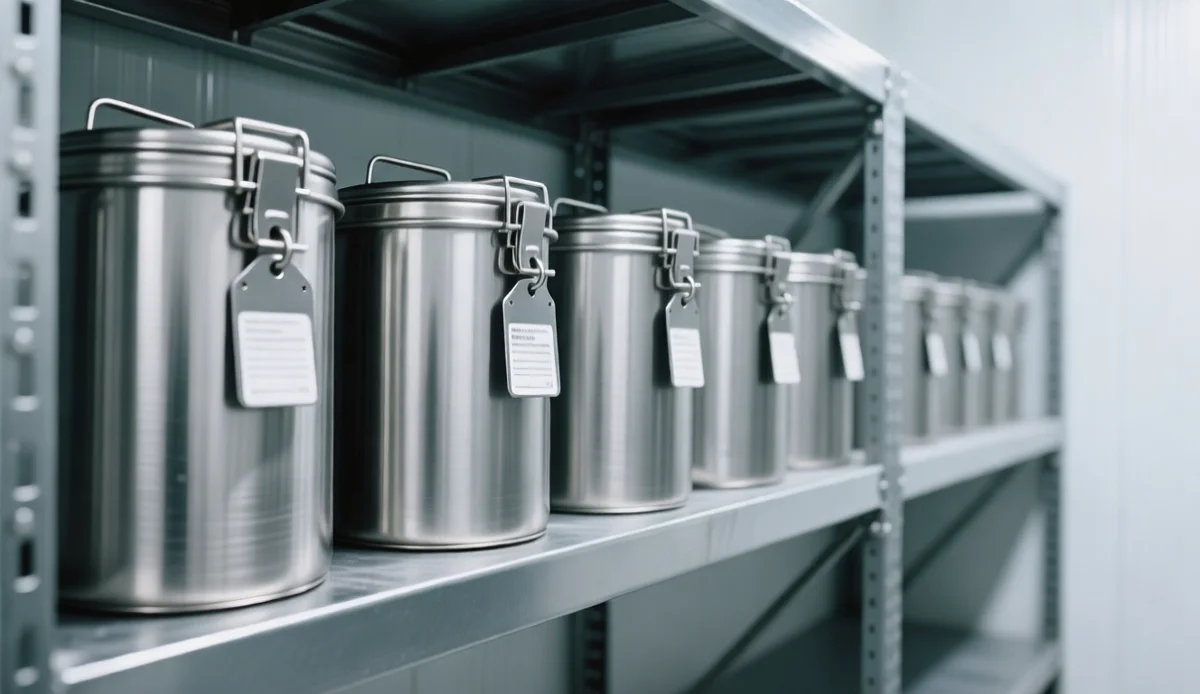
GB/T 44237-2024 requires durable marking of alloy, lot, mass, and hazard information on AM powder packaging. We weld-attach a 316L tag rather than adhesive labels, which fail in cold or humid storage.
4. Sizes That Match Real Powder Batches
| Volume | Typical payload (stainless powder ≈ 4.4 kg/L loose) | Use case |
|---|---|---|
| 5 L | ~15–20 kg | Printer-side transfer can, R&D lots |
| 10 L | ~30–40 kg | Standard machine refill container |
| 20 L | ~60–80 kg | Atomizer batch storage, shipping drum alternative |
| 50–100 L hopper | 150–400 kg | Sieving station feed, central powder room |
Wall thickness is modest — 1.5 to 3 mm is normal because these vessels carry powder, not pressure — but the lid and clamp ring take the handling loads, and drop integrity matters more than pressure rating. If your logistics include air freight, specify stackable lids and ISO container-compatible footprints.
5. Standards and Documents to Ask For
- GB/T 44237-2024 — Additive manufacturing metal powder: packaging, marking, transport and storage. Increasingly referenced in Chinese export contracts; covers container integrity, labeling, and storage environment classes.
- NFPA 484 (US) — Combustible metals; governs how Al/Ti powder containers must be stored and grounded.
- EN 10204 3.1 — Mill certificates for the stainless itself; how to read one is in our MTR verification guide.
- ISO 4287 — The Ra measurement method for interior finish claims.
- ATEX zone classification — Where required, the canister’s grounding scheme should be documented in your zone assessment.
A serious supplier will answer “which of these do your canisters comply with, and how do you prove it” in one email. If the answer is only “stainless steel, good quality,” keep looking.
6. Buyer’s Checklist Before You Order
- Alloy and powder type the canister will hold (drives 304 vs 316L, seal choice)
- Volume and tare-weight limit (manual handling stops at ~25 kg payload without lifting aids)
- Interior finish spec (Ra value + measurement report)
- Lid type + purge port fitting standard (Swagelok-compatible is common)
- Discharge valve type and whether it is grounded/bonded
- Marking method for alloy/lot (welded tag vs engraving)
- Documents: EN 10204 3.1 MTR, finish report, leak test if purge-tight sealing is claimed
FAQ
Can one canister serve different alloys?
No. Even after cleaning, microscopic residues in seams and valve seats cause cross-contamination that XRF screening catches at your customer’s end. One alloy per canister, permanently marked.
Is a plastic drum good enough for powder storage?
For shipping virgin powder once, drums are common. For repeated plant handling, plastic sheds micro-particles, builds static charge, and cannot be purged or grounded reliably — that is why AM powder rooms standardize on stainless.
What does a powder canister cost?
Simple 10 L 316L canisters with clamp lid and purge port typically land in the $150–400 range depending on finish and valve spec; 50–100 L grounded hoppers run higher. Send a drawing or a sketch with dimensions for an exact quotation.
Do you need pressure certification?
Not for atmospheric powder storage. If you want the same vessel to act as a pressurized feed container (some powder feed systems run slight positive pressure), say so up front — the design and test regime changes to pressure-vessel practice.
How is leak-tightness verified?
For purge-tight canisters, a simple pressure-hold test at 0.2–0.5 bar with soap-bubble checks on seams and ports is the practical standard; ask for the test record per unit or per batch.
Get a Quotation You Can Verify
Send the alloy, powder type, volume, and whether you need purge-tight sealing or a grounded discharge valve. Within two working days you receive a GA drawing, the interior finish spec with measurement method, an EN 10204 3.1 documentation list, and a line-item price — request a quote or see our tank ordering guide and China sourcing guide for the broader process.