
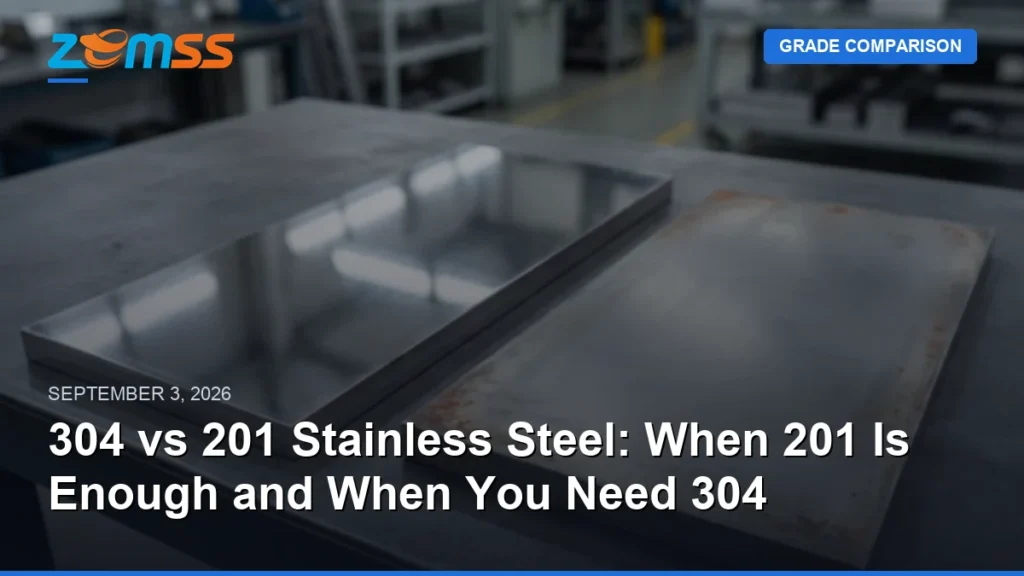
304 vs 201 Stainless Steel: When 201 Is Enough and When You Need 304
The short answer: 201 wins on price, 304 wins on corrosion resistance, and the decision comes down to how wet, salty, or corrosive the service environment is. If your part lives indoors, stays dry, and never touches salt or chemicals, 201 can save you 20–30% on material. If it touches water, coastal air, food acids, or cleaning chemicals, 304 is the safe choice — and the corrosion problems 201 develops are usually expensive enough to erase any savings.
This guide breaks down the chemistry, corrosion behaviour, strength, and real cost difference between 304 vs 201 stainless steel, then gives you an industry-by-industry framework for choosing. If you are deciding between two corrosion-resistant grades instead, see our 304 vs 316L comparison and 304L vs 316L guide.
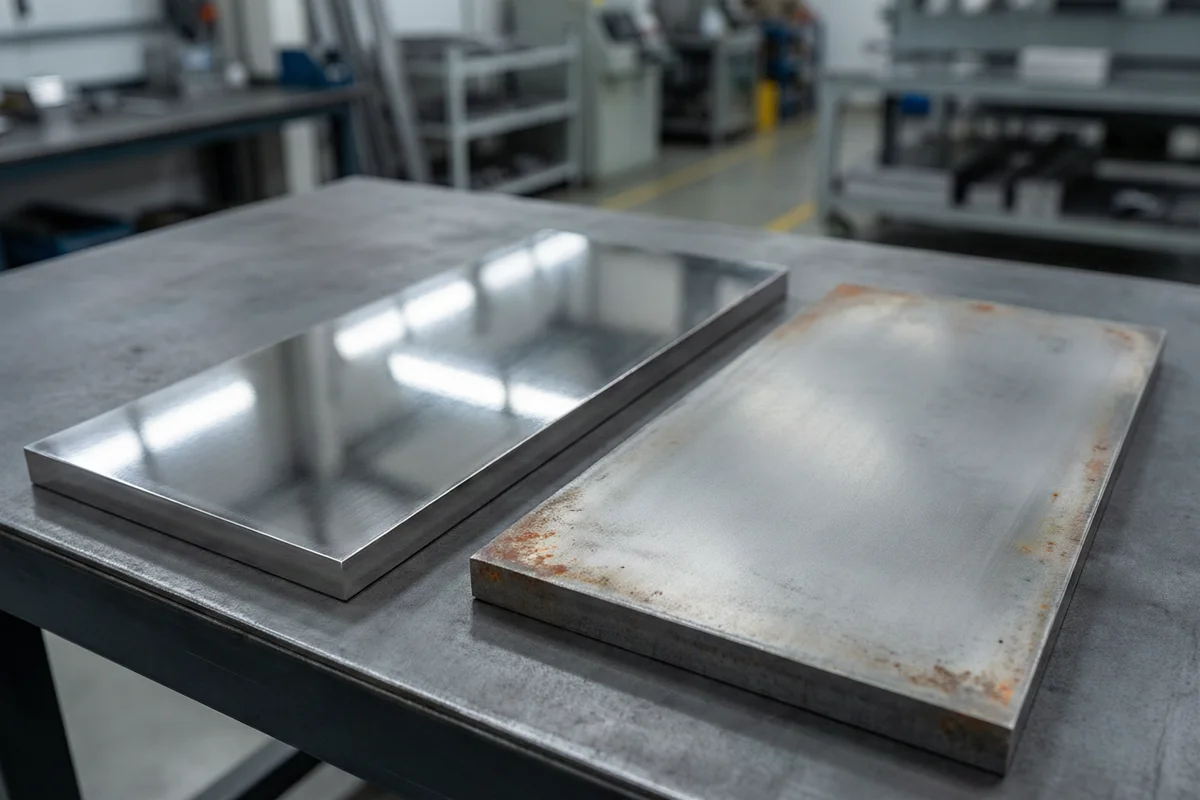
Chemical Composition: Nickel Is the Whole Story
The defining difference between 201 and 304 is nickel. 304 is the classic 18/8 stainless — about 18% chromium and 8% nickel. 201 replaces most of that expensive nickel with manganese and nitrogen, which is exactly why it costs less. But nickel is what gives austenitic stainless its corrosion resistance and formability, so cutting it has consequences.
| Element | 201 (UNS S20100) | 304 (UNS S30400) | Why it matters |
|---|---|---|---|
| Chromium (Cr) | 16.0–18.0% | 18.0–20.0% | Base corrosion resistance |
| Nickel (Ni) | 3.5–5.5% | 8.0–10.5% | The big one — corrosion + ductility |
| Manganese (Mn) | 5.5–7.5% | 2.0% max | 201 uses Mn to replace Ni |
| Nitrogen (N) | 0.25% max | 0.10% max | Boosts strength in 201 |
| Carbon (C) | 0.15% max | 0.08% max | 201 runs higher carbon |
201 is sometimes called “low-nickel” or “manganese stainless.” That lower nickel content is the root of every difference below — lower corrosion resistance, slightly different welding behaviour, and the lower price.
Corrosion Resistance: Where 201 Falls Short
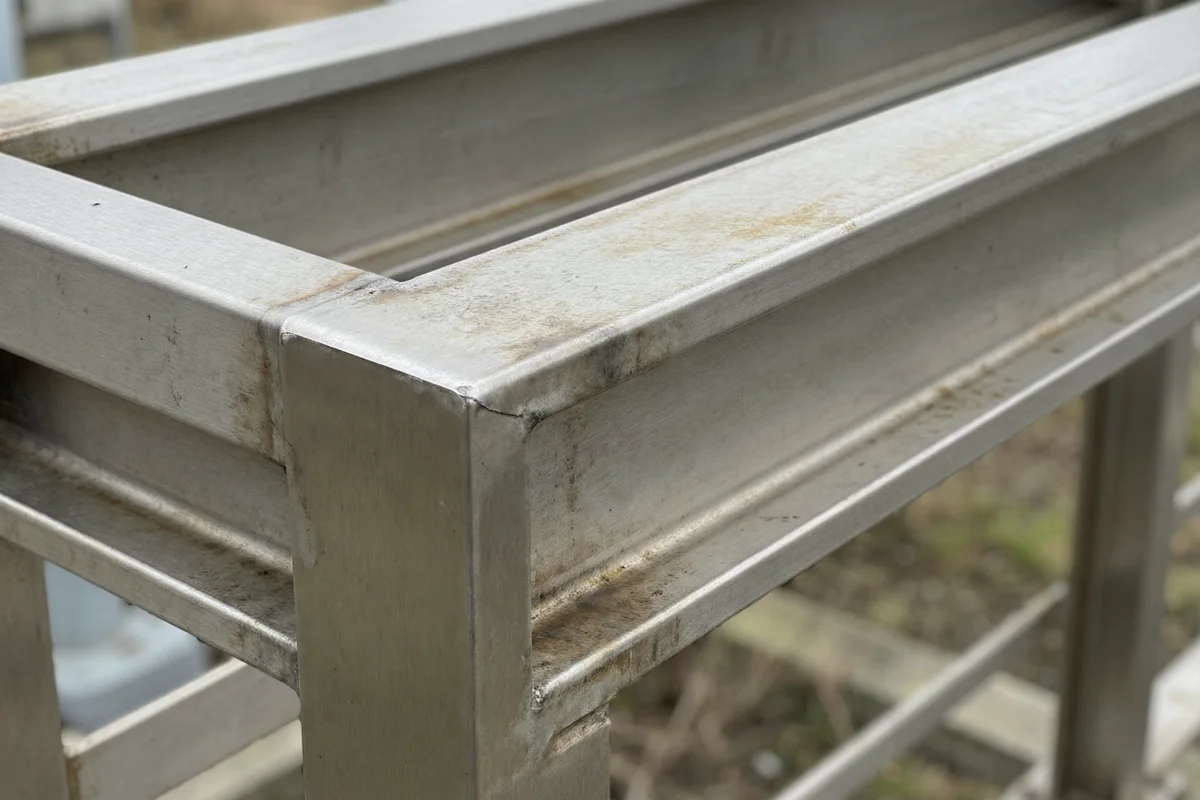
This is the honest part of the comparison. 201 is meaningfully less corrosion-resistant than 304. The lower nickel and chromium content means 201 is more prone to:
- Rust staining in humid or outdoor environments, especially where moisture sits on the surface
- Pitting corrosion when exposed to chlorides — salt water, coastal air, de-icing salts, many cleaning agents
- Surface rust after fabrication, particularly around welds and cut edges where the protective layer is disturbed
A useful shorthand is the PREN (Pitting Resistance Equivalent Number), calculated as %Cr + 3.3×%Mo + 16×%N. Higher is better. 304 lands around 18–20; 201 is noticeably lower because its chromium is at the low end and it has almost no nickel to stabilise the passive film. In practical terms: 304 handles outdoor, coastal, food-contact, and chemical exposure well; 201 is best kept indoors and dry.
How each environment treats the two grades:
- Indoor, dry, climate-controlled — both perform well; 201 is a genuine saving here.
- Humid interiors (bathrooms, kitchens, laundries) — 304 is safer; 201 can develop surface staining over time.
- Outdoor / rain exposure — 304. 201 will rust, often within months, especially at cut edges and welds.
- Coastal / salt-laden air — 304 minimum; many coastal jobs justify 316. 201 will pit and stain quickly.
- Food acids, vinegar, tomato, citrus — 304. Food acids attack 201, and 304 is the accepted food-contact grade.
- Cleaning chemicals / chlorides — 304 minimum. Chloride-containing cleaners pit 201 readily.
Mechanical Properties: 201 Is Actually Stronger
Here 201 surprises people. Thanks to its manganese and nitrogen, 201 has higher yield and tensile strength than 304 — roughly 20–30% stronger in yield. That can let you use slightly thinner material for the same structural load. The trade-off is that 201 is a bit less ductile and work-hardens faster, which can matter for deep drawing or heavy forming.
| Property | 201 | 304 |
|---|---|---|
| Yield strength (annealed) | ~380 MPa | ~205 MPa |
| Tensile strength | ~655 MPa | ~515 MPa |
| Formability / ductility | Good, work-hardens faster | Excellent, easier to form |
| Corrosion resistance | Moderate | Very good |
Cost: Why People Consider 201 in the First Place
201 is cheaper because nickel is expensive and 201 uses far less of it. Depending on nickel prices, 201 typically costs 20–30% less than 304. On a large structural order that is real money.
But price is only half the equation. Ask what the corrosion will cost. If a 201 part rusts in service, you pay for the replacement, the labour to swap it, and possibly the downtime or reputation hit. In corrosive service, that often costs more than the nickel you saved. The rule of thumb: the wetter or saltier the environment, the worse the 201 “discount” looks.
A quick worked example. Say a run of indoor shelving brackets needs 500 kg of stainless. At a rough 25% premium for 304, choosing 304 might add a few hundred dollars on the material. On a dry interior job, that premium buys long-term safety and the brackets likely outlast the building — reasonable. Now take an outdoor handrail in a coastal town: if 201 starts rusting in year one, you pay to replace it, refinish it, and manage the complaint — which typically costs several times the nickel you saved. On corrosive jobs, 304 is almost always the cheaper choice over the part’s life.
Availability deserves a word too. 304 is the most stocked stainless in the world — every form, finish, and size, with short lead times everywhere. 201 is widely available as well, but its stocking range is narrower: strong in decorative tube, strip, and sheet for the furniture and appliance trades, thinner in heavy plate, special finishes, and fittings. If your 201 requirement is in an unusual form, price the real lead time before banking on the discount — our sheet and plate buyer guide covers what to check on any stainless purchase.
Industry-by-Industry Selection Guide
| Application | Recommended | Why |
|---|---|---|
| Indoor dry structural / frames | 201 OK | No moisture = 201 holds up, saves cost |
| Decorative indoor trim | 201 OK | Dry, cosmetic, low corrosion demand |
| Outdoor structures / fencing | 304 | Rain + weather will rust 201 |
| Coastal / marine | 304 (316 better) | Salt destroys 201 quickly |
| Food-contact / kitchen | 304 | Food acids + washdown; 304 is food-safe standard |
| Chemical / processing | 304 or 316 | Chemicals attack 201 |
| Appliance exteriors (dry) | 201 OK | Dry cosmetic panels |
Common Misconceptions About 201
A few myths about 201 cause buyers to make costly mistakes. Clearing them up usually settles the decision quickly.
“201 is just as good as 304, it’s all stainless.” The most common and most expensive mistake. Both are stainless, but 201’s low nickel means it corrodes noticeably faster in wet, salty, or acidic service. “Stainless” is a family, not a single performance level.
“If it’s magnetic, it’s not real stainless.” Not useful here. Both 201 and 304 are austenitic and normally non-magnetic, though cold working can make either slightly magnetic. Magnetism doesn’t distinguish them; chemistry does. The reliable test is the mill certificate or an XRF/chemical spot check.
“201 will rust immediately.” Not quite. In dry indoor service, 201 can last years without visible rust. The problem shows up in damp, outdoor, or coastal conditions — often within months, and usually at welds and cut edges first. So 201 isn’t worthless; it is just environment-limited.
“201 isn’t weldable.” It welds, but its weld zone is more corrosion-prone than 304’s. Use appropriate filler (typically 308/308L) and good shielding, and avoid using welded 201 in corrosive service.
Surface Finish: Matters More Than People Think
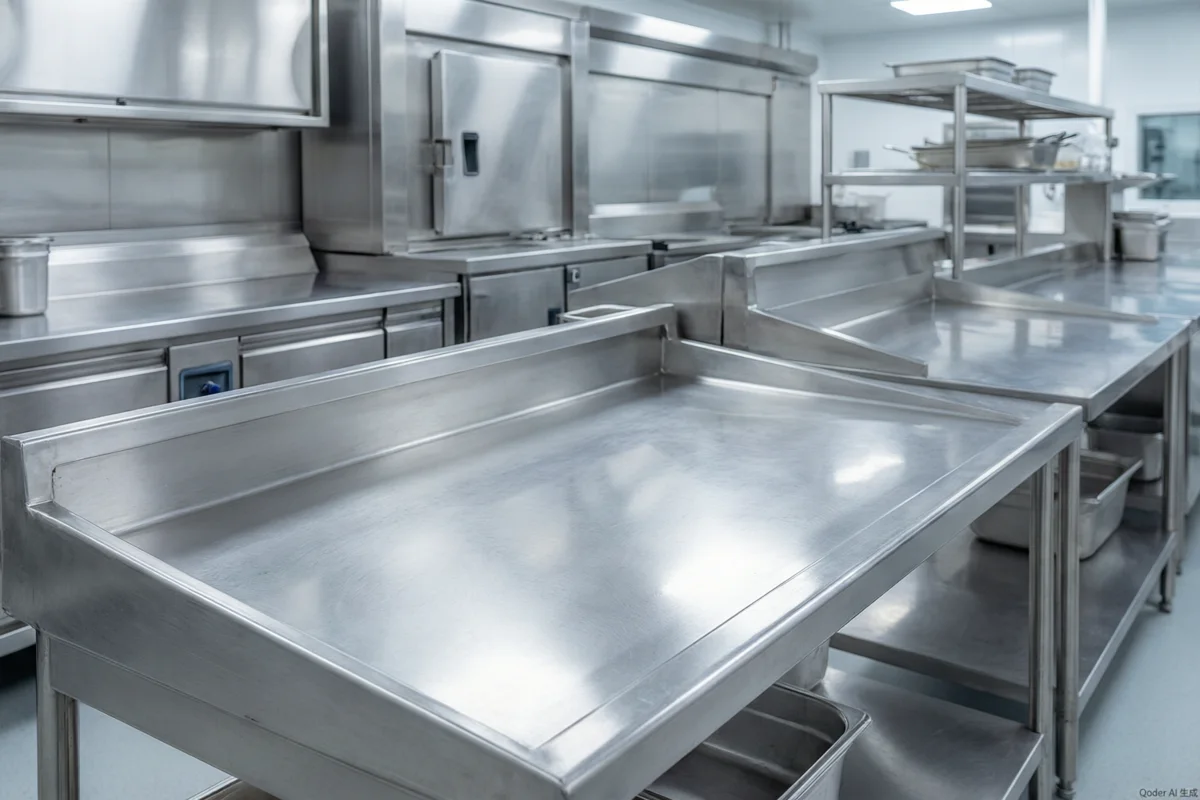
Surface finish affects both appearance and corrosion behaviour, and it is often where 201 vs 304 decisions quietly go wrong. A smoother, cleaner finish resists staining better because there are fewer places for moisture and contaminants to sit. Our surface finishing guide covers the full range — here is how the common ones interact with this choice.
2B finish (the standard cold-rolled mill finish) is fine for both grades in dry service. Brushed (No.4) is popular for visible surfaces but its grain can trap moisture and grime, which hurts 201 outdoors faster than 304. Mirror (8K) polish sheds contaminants best but costs more. For any 201 part, a cleaner finish is your friend; for harsh service, no finish rescues 201 — choose 304 instead. And remember cut edges and welds are the weakest points: they disturb the protective film and are where rust usually starts first, on either grade.
Welding and Fabrication Notes for Procurement Teams
Both weld readily, but keep three points in mind. First, 201’s higher carbon and lower nickel make its weld zone a little more susceptible to corrosion, so welded 201 parts in damp service are a weak point. Second, 201 work-hardens faster, which matters for bending and forming — tell your fabricator the grade up front. Third, if you are unsure whether stock is really 304, ask for the mill test certificate; low-nickel material is occasionally substituted, and an MTR is your proof — our MTR verification guide shows how to read one. We supply material with mill certification and can walk through grade selection for your specific service conditions.
Frequently Asked Questions
The questions buyers ask most about 304 vs 201 stainless steel, answered directly.
Is 201 stainless steel rust-proof?
No. 201 is “stainless” but not rust-proof. It resists light corrosion when kept dry, but it will develop rust staining and pitting in humid, outdoor, or salty environments. For anything exposed to moisture, 304 is the reliable choice.
Can I use 201 instead of 304 to save money?
Only if the part stays indoors and dry. In dry interior applications, 201 saves 20–30% and performs fine. In any wet, outdoor, coastal, food, or chemical service, 304 is worth the difference because 201 will corrode.
Is 201 stainless steel food-safe?
Generally not recommended for food contact. 304 is the accepted food-grade stainless; its higher nickel and chromium hold up to food acids and washdown. Use 304 for anything touching food.
Is 201 stronger than 304?
Yes. 201 has roughly 20–30% higher yield strength thanks to its manganese and nitrogen. That strength is real, but it comes with lower corrosion resistance, so don’t trade corrosion for strength where corrosion matters.
How can I tell if material is really 304 and not 201?
Ask for the mill test certificate — it states the actual chemistry. A quick chemical spot test or XRF analyser can also distinguish them, since 201 has far less nickel. If price seems too good for genuine 304, verify.
Is 201 harder to form or bend than 304?
Somewhat. 201 work-hardens faster and is a little less ductile, so tight bends and deep drawing are harder than with 304. For simple bending and structural shapes it is fine; for complex forming, 304 is easier and more forgiving. Tell your fabricator the grade so they can adjust tooling and bend radii.
What filler should I use when welding 201 or 304?
308/308L filler is standard for 304. For 201, a 308-type filler is commonly used, but because 201 welds are more corrosion-prone, many fabricators prefer 308L and good shielding gas. If the weld will see moisture or corrosive service, favour 304/308L and discuss it with your fabricator — weld corrosion is 201’s weak point.
Can 201 be used for kitchen sinks or food tables?
Not recommended. Sinks and food-contact tables live in a constant cycle of water, food acids, and cleaning chemicals — exactly the conditions where 201 stains and pits. 304 is the accepted food-grade stainless for these products, and the price difference is small against the cost of rust complaints.
Conclusion: A Simple Decision Framework
Ask two questions. First: will it get wet, salty, or chemically exposed? If yes, use 304 — no debate. Second: is it a dry, indoor, structural or decorative part? If yes, 201 is a legitimate way to save 20–30%. When in doubt — especially for anything outdoors, coastal, food-related, or hard to replace — default to 304. The corrosion problems 201 causes in the wrong application almost always cost more than the nickel you saved. If you would like a second opinion on the 304 vs 201 choice for a specific part, send us the application and environment and we will recommend the grade with certification.
References: ASTM A240 / A240M — Standard Specification for Chromium and Chromium-Nickel Stainless Steel Plate, Sheet, and Strip (ASTM). 1 Nickel Institute — guidance on austenitic stainless steel selection and corrosion behaviour (nickelinstitute.org). 2 British Stainless Steel Association — advisory material on 200-series stainless grades (bssa.org.uk). 3