
Stainless Steel Fabrication for Pressure Vessels: ASME Code Materials, Welding & NDT Requirements
By Chen Ming, Senior Fabrication Engineer | June 13, 2026 | 9 min read
A pressure vessel is not just a tank — it’s a coded pressure boundary where a single weld defect can cause catastrophic failure. Stainless steel pressure vessel fabrication under ASME Section VIII imposes strict requirements on materials, welding, inspection, and documentation that go well beyond standard fabrication. At Zeming, we’ve fabricated stainless pressure vessels for chemical processing, boiler systems, and environmental equipment — this guide covers what engineers and procurement teams need to know to spec and source these components correctly. See: ASME Boiler and Pressure Vessel Code Section VIII.
1. ASME Code Framework for Stainless Vessels
The governing documents for stainless steel pressure vessel fabrication are:
- ASME Section II, Part A (SA-240): Material specification for stainless steel plate, sheet, and strip for pressure vessels. Defines chemistry, mechanical properties, and testing requirements.
- ASME Section II, Part D: Allowable stress values (Table 1A for ferrous materials). Determines minimum wall thickness for a given design pressure, diameter, and temperature.
- ASME Section VIII, Division 1: Rules for construction of pressure vessels. Covers design, fabrication, inspection, testing, and certification.
- ASME Section IX: Qualification of welding procedures (WPS/PQR) and welder performance qualification (WPQ).
- ASME Section V: Nondestructive examination methods (RT, UT, PT, MT).
Furthermore, Every vessel shipped with a U-Stamp (ASME Code Symbol Stamp) has been fabricated, inspected, and documented in full compliance with these sections — verified by an Authorized Inspector (AI) from an ASME-accredited Authorized Inspection Agency.
Stainless Steel Pressure Vessel Fabrication: 2. Material Selection for Pressure Vessel Service
| Grade | SA-240 Type | Allowable Stress at 200°C (MPa) | Typical Application |
|---|---|---|---|
| 304L | SA-240 304L | 115 | General chemical storage, water tanks, low-pressure steam |
| 316L | SA-240 316L | 115 | Chloride-containing media, chemical reactors, marine service |
| 2205 | SA-240 S32205 | 192 | High-pressure, chloride SCC risk, weight-optimized designs |
| 310S | SA-240 310S | 77 (at 600°C) | High-temperature reactors, thermal oxidizers |
The higher allowable stress of 2205 (192 MPa vs 115 MPa for 304L/316L) means a 2205 vessel can be designed with approximately 40% thinner walls than a 304L vessel for the same pressure rating — reducing weight, material cost, and welding labor. This is why 2205 has become the standard for high-pressure stainless steel vessels in weight-sensitive applications like offshore platforms and transportable equipment. Full duplex 2205 guide. See: ISO 16528 pressure vessel standards.
3. Welding — The Heart of Coded Fabrication
Therefore, Every weld on an ASME pressure vessel must be made to a qualified Welding Procedure Specification (WPS) backed by a Procedure Qualification Record (PQR). The WPS defines: process (TIG for root passes, MIG or SAW for fill), filler metal (ER308L, ER316L, ER2209), shielding gas, preheat (generally none for austenitic SS), interpass temperature (≤150°C), heat input limits, and post-weld treatment.
Key requirements for ASME stainless vessel welds:
- Full penetration on all Category A (longitudinal) and Category B (circumferential) joints
- Back-purging with argon on the inside of pipe and nozzle welds to prevent oxidation (“sugaring”) on the root side
- Low carbon filler metals (ER308L, ER316L) to prevent intergranular corrosion — mandatory for service above 425°C or in corrosive environments
- Weld reinforcement limits — typically ≤3mm for plate up to 25mm thick, per UW-35
- Alignment tolerances — maximum offset of 1/4 of the thinner plate thickness for longitudinal seams (UW-33)
4. Nondestructive Testing (NDT) Requirements
| NDT Method | What It Detects | Typical Coverage |
|---|---|---|
| RT (Radiography) | Internal porosity, slag, lack of fusion, cracks | Full (100%) or spot (5–10%) per UW-11/12 |
| UT (Ultrasonic Testing) | Internal defects, lamination in base metal | Alternative to RT, or supplementary |
| PT (Liquid Penetrant) | Surface-breaking defects on non-magnetic materials | 100% of accessible weld surfaces |
| VT (Visual Inspection) | Surface irregularities, undercut, reinforcement | 100% — mandatory baseline |
| PMI (Positive Material Identification) | Alloy verification (wrong grade installed) | 100% of pressure boundary materials |
Full radiography is mandatory for: lethal-service vessels, unfired steam boilers above 350 kPa, vessels with joint efficiency of 1.0, and vessels with wall thickness exceeding specified limits. Spot radiography (minimum one radiograph per 15 meters of weld) applies to standard vessels designed with a joint efficiency of 0.85. For stainless steel, liquid penetrant testing on all weld surfaces is standard practice — unlike carbon steel, magnetic particle (MT) cannot be used since austenitic stainless is non-magnetic.
5. Hydrostatic Testing — The Final Proof
Every ASME Section VIII vessel undergoes hydrostatic testing at 1.3× the Maximum Allowable Working Pressure (MAWP) multiplied by the ratio of material allowable stress at test temperature to allowable stress at design temperature (typically 1.3 × MAWP for vessels tested at ambient temperature with shells designed for elevated service). The test is witnessed by the Authorized Inspector, and the vessel must hold pressure with zero visible leakage for the specified duration (minimum 30 minutes for most vessels).
6. Documentation Package
A complete ASME vessel data package includes:
- U-1 Manufacturer’s Data Report — the legal document certifying ASME compliance
- Material Test Certificates (EN 10204 3.1 or 3.2) for all pressure boundary materials, with heat number traceability
- WPS/PQR/WPQ documentation for all welding procedures and welders
- NDT reports (RT films or digital images, PT reports, VT reports)
- Hydrostatic test report
- Dimensional inspection report — shell roundness, nozzle location, flange orientation
- Nameplate drawing showing U-Stamp location and data
7. Minimizing Cost on Coded Vessels
Consequently, The biggest cost drivers in stainless steel pressure vessel fabrication are: (1) over-specifying NDT — requiring 100% RT on a vessel that qualifies for spot RT under code adds significant cost, (2) specifying unnecessarily tight dimensional tolerances beyond code requirements, and (3) not optimizing the grade selection — using 316L where 304L would suffice, or not considering 2205 for weight-critical designs. Our engineering team reviews every vessel specification for these opportunities before quoting. Discuss your pressure vessel requirements with us.
Specifying a stainless steel pressure vessel? Contact Zeming’s engineering team with your design parameters — MAWP, design temperature, media, and applicable code — for a technical review and quotation. Explore our ASME-qualified welding services, CNC rolling and bending, and grade selection resources.
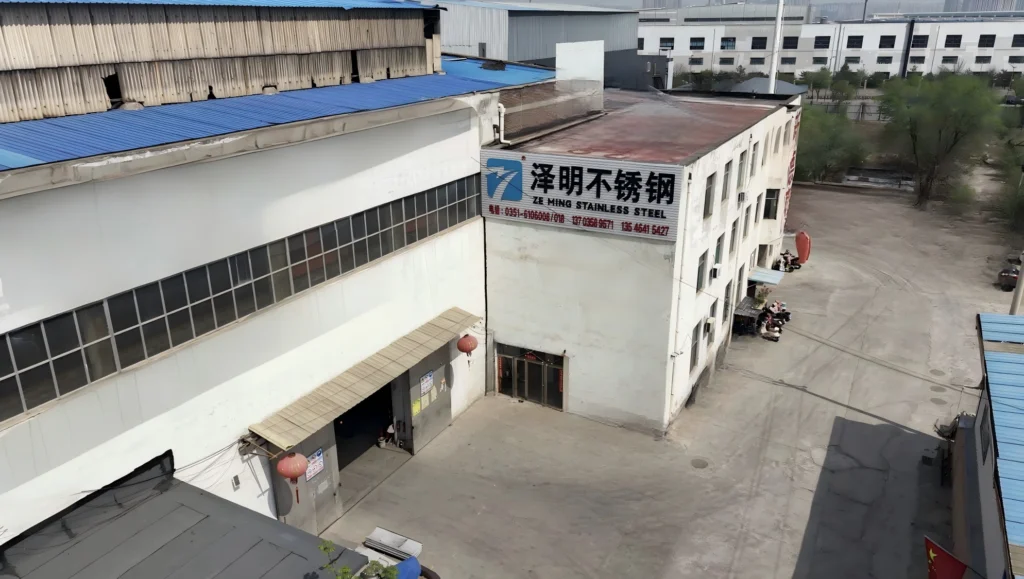
About the Author: Chen Ming, Senior Fabrication Engineer at Shanxi Zeming Environmental Technology Co., Ltd. 20+ years in coded pressure vessel fabrication and ASME Section VIII compliance.
Quality Documentation Requirements for ASME Pressure Vessels
Material Traceability
Every pressure-retaining component must be traceable to its mill heat number. At Zeming, we maintain a digital material traceability system that links each heat number to the final vessel serial number. This means if a material non-conformance is discovered years after installation, the affected vessels can be identified and isolated within hours — not weeks.
Welder Qualification Records
ASME Section IX requires every welder to be qualified for each welding process, position, and material group used on the project. Zeming maintains current WPQ (Welder Performance Qualification) records for all 10+ certified welders, covering GTAW, GMAW, FCAW, and SAW processes on P8 (austenitic stainless) base materials. These records are included in the final documentation package at no additional cost.
NDT Documentation
Non-destructive testing reports — including RT (radiographic testing), UT (ultrasonic testing), PT (liquid penetrant), and PMI (positive material identification) — must be compiled into a single indexed document. Zeming organizes all NDT reports by weld map reference number, making it straightforward for the Authorized Inspector to cross-reference each weld with its inspection record during the final vessel certification review.
Practical Tips for Pressure Vessel Buyers
First, engage your fabrication partner during the design phase, not after the drawings are finalized. Early collaboration allows the fabricator to suggest material substitutions that reduce cost without compromising safety — for example, using dual-certified 304/304L plate instead of specifying 304L exclusively, which may have longer lead times and higher cost for the same performance.
Second, specify NDT requirements clearly in the purchase order. A phrase like “RT as required by Code” is ambiguous — state the exact percentage (e.g., “full RT on all Category A and B longitudinal and circumferential welds, spot RT on Category C and D nozzle attachment welds per UW-11(a)”).
Third, budget for a third-party Authorized Inspector even when the fabricator holds their own ASME stamp. An independent AI provides an additional layer of verification that protects your investment and ensures full Code compliance.
Material Selection for Stainless Steel Pressure Vessels
304/304L: The Workhorse Grade
304 and its low-carbon variant 304L are the most commonly specified stainless steels for general-purpose pressure vessels operating below 400°C. The low carbon content of 304L (≤0.03%) prevents intergranular carbide precipitation during welding, eliminating the need for post-weld solution annealing on sections up to 8mm thick. For thicker sections, 304H (high carbon) may be specified for elevated-temperature strength above 500°C, per ASME BPVC Section II Part D allowable stress tables.
316L: When Corrosion Resistance Matters
The addition of 2–3% molybdenum in 316L provides superior resistance to pitting and crevice corrosion in chloride-containing environments. Pressure vessels handling brackish water, chemical intermediates, or marine atmospheres should default to 316L. The PREN (Pitting Resistance Equivalent Number) for 316L is approximately 24–26, compared to 18–20 for 304 — making 316L roughly 30% more resistant to chloride pitting. However, 316L costs approximately 40–50% more than 304L, so the selection should be driven by a genuine corrosion requirement, not as a blanket upgrade.
2205 Duplex: High Strength, High Corrosion Resistance
For pressure vessels requiring both high strength and excellent chloride resistance, 2205 duplex stainless steel offers twice the yield strength of 304L (≥450 MPa vs ≥205 MPa) with a PREN of 34–36. The higher strength allows for thinner wall thicknesses — a vessel designed in 304 at 12mm wall thickness could potentially be designed in 2205 at 7mm, reducing weight by 40% and material cost despite the higher per-kilogram price. However, 2205 requires careful welding procedure control to maintain the austenite-ferrite phase balance, and is limited to service temperatures between -50°C and 300°C per ASME BPVC Section VIII Div.1 UHA-51.