
2205 Duplex Stainless Steel: Properties, Fabrication Challenges & Industrial Applications
2205 duplex stainless steel fabrication is one of the most rewarding yet technically demanding capabilities in modern industrial manufacturing. Accounting for nearly 48% of all duplex stainless steel sold globally, 2205 (UNS S32205 / EN 1.4462) has become the material of choice for engineers designing against chloride corrosion, high operating pressures, and aggressive chemical environments. At ZEMSS, our materials engineering team has fabricated thousands of tonnes of 2205 components, from ASME-coded pressure vessels to subsea manifolds. This guide distills that shop-floor experience into a practical reference covering the metallurgy behind 2205’s strength, the fabrication pitfalls that can derail a project, and the industrial applications where 2205 delivers the highest return on investment.
What Makes 2205 Different: The Duplex Microstructure
Unlike 300-series austenitic grades (304, 316L) with their single-phase austenite structure, 2205 belongs to the duplex family — combining approximately 50% austenite and 50% ferrite in a balanced two-phase structure. This phase balance is the origin of 2205’s defining characteristics: roughly double the yield strength of 316L, virtual immunity to chloride stress corrosion cracking (SCC), and a PREN high enough for seawater service.
The term “duplex microstructure” describes this coexistence of face-centered cubic (FCC) austenite and body-centered cubic (BCC) ferrite grains, engineered through controlled nitrogen alloying (0.14–0.20%) and solution annealing at 1,050–1,080°C followed by rapid quenching. Nitrogen strengthens the austenite while chromium (22%) and molybdenum (3.0–3.5%) concentrate in the ferrite, giving both phases complementary corrosion resistance. The alternating lamellar austenite-ferrite structure resists crack propagation far better than either phase alone.
| Element | Weight % | Role in 2205 |
|---|---|---|
| Chromium (Cr) | 22.0 – 23.0 | Primary passive film former; drives high PREN |
| Nickel (Ni) | 4.5 – 6.5 | Austenite stabilizer; balances phase ratio |
| Molybdenum (Mo) | 3.0 – 3.5 | Enhances pitting/crevice resistance in chlorides |
| Nitrogen (N) | 0.14 – 0.20 | Austenite strengthener; major PREN contributor (×16 multiplier) |
| Manganese (Mn) | ≤ 2.00 | Deoxidizer; nitrogen solubility aid |
| Silicon (Si) | ≤ 1.00 | Deoxidizer |
| Carbon (C) | ≤ 0.030 | Kept low to avoid carbide sensitization |
| Phosphorus (P) | ≤ 0.030 | Residual; controlled for weldability |
| Sulfur (S) | ≤ 0.020 | Residual; 0.001% preferred for GTAW |
| Iron (Fe) | Balance | Matrix |
Mechanical Properties: 2205 vs 316L vs 304
The most immediate value proposition of 2205 duplex stainless steel fabrication is mechanical: at 450 MPa minimum yield strength, 2205 is over 2.6× stronger than 316L (170 MPa) and 2.2× stronger than 304 (205 MPa). This allows engineers to reduce wall thickness by 30–50% in pressure-containing equipment while maintaining identical pressure ratings under ASME B31.3 or ASME Section VIII Division 1. Thinner sections mean less filler metal, fewer weld passes, lighter support structures, and lower total installed cost — often offsetting 2205’s higher per-kilogram price completely before corrosion savings are counted.
| Property | 304 (UNS S30400) | 316L (UNS S31603) | 2205 (UNS S32205) | 2205 Advantage |
|---|---|---|---|---|
| Yield Strength (0.2% offset), MPa | 205 | 170 | 450 | 2.2× 304 / 2.6× 316L |
| Tensile Strength, MPa | 515 | 485 | 655 | 35% higher |
| Elongation, % (50 mm) | 40 | 40 | 25 | 316L more ductile |
| Hardness, HBW (max) | 201 | 217 | 293 | 2205 harder → more wear-resistant |
| Elastic Modulus, GPa | 193 | 193 | 200 | Comparable |
| Density, kg/m³ | 8,000 | 8,000 | 7,810 | Slightly lighter |
| Thermal Conductivity, W/m·K | 15 | 16 | 15 | Comparable |
| ASME Allowable Stress (100°C), MPa | ~138 | ~115 | ~187 | 60% higher design stress |
The trade-off is ductility: 2205’s 25% elongation is lower than 316L’s 40%, and its ductile-to-brittle transition temperature around −50°C excludes it from cryogenic service. Similarly, 2205 should not be operated continuously above 250–300°C due to “475°C embrittlement” (ferrite spinodal decomposition) and sigma phase precipitation. Within the −50°C to +250°C envelope, however, 2205’s strength-to-weight ratio is unmatched among standard stainless grades.
Corrosion Resistance: PREN 34–38 and Chloride SCC Immunity
The defining corrosion metric for duplex stainless steel is the Pitting Resistance Equivalent Number (PREN), calculated as:
PREN = %Cr + 3.3 × %Mo + 16 × %N
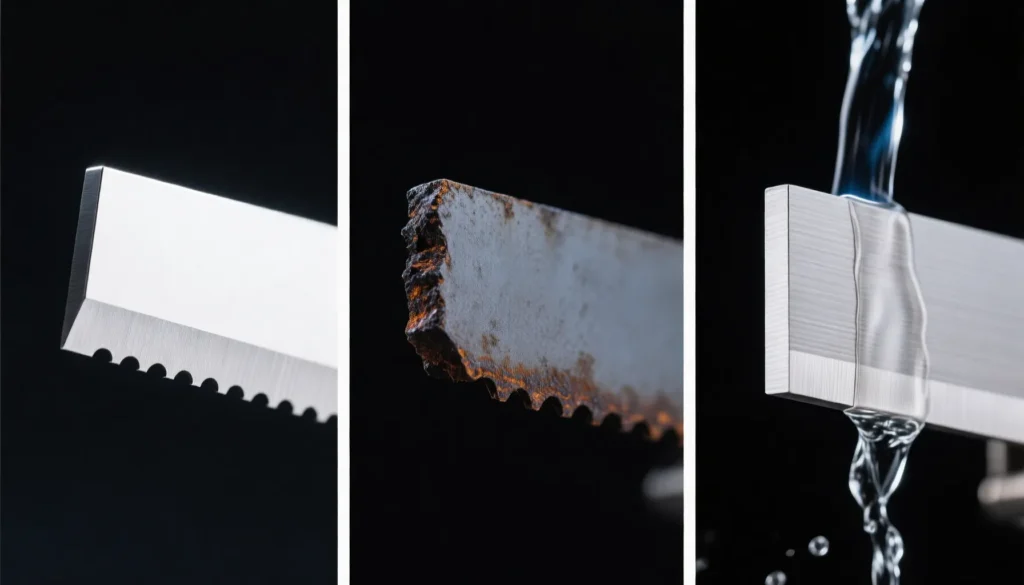
For 2205 (22% Cr, 3.1% Mo, 0.17% N), PREN calculates to approximately 35 — placing it well above the PREN 30 threshold generally accepted for seawater-handling service. By comparison, 316L (PREN ~24–25) and 304 (PREN ~18–19) fall far short: 316L heat exchanger tubing in warm seawater can perforate from pitting within 12–18 months, while 2205 tubing in the same service lasts 15–25 years.
Equally critical is 2205’s virtual immunity to chloride stress corrosion cracking (SCC) — the failure mechanism that has plagued austenitic stainless steels in hot chloride environments for decades. The ferrite phase mechanically arrests SCC cracks that propagate through austenite, dramatically widening the safe operating envelope. NORSOK M-001 specifies 2205 for seawater systems up to approximately 50°C; above that, super duplex 2507 (PREN ≥40) is recommended for continuous immersion.
| Environment | 316L Expected Life | 2205 Expected Life |
|---|---|---|
| Fresh water, Cl⁻ < 200 ppm, ambient | 20+ years | 40+ years |
| Brackish water, 5,000 ppm Cl⁻, 30°C | 3–7 years | 20+ years |
| Seawater, ambient (35,000 ppm Cl⁻) | 1–4 years | 25+ years |
| Seawater, warm (40°C, heat exchanger) | <1 year | 15–20 years |
| Chloride SCC risk (hot Cl⁻, stressed) | High risk | Immune (within limits) |
Fabrication Challenges: Why 2205 Is Harder to Work With
If 2205 were easy to fabricate, 316L would have been obsolete decades ago. The reality at our stainless steel processing workshop is that 2205 duplex stainless steel fabrication demands tighter process control at every stage. Understanding these challenges upfront separates projects that deliver 25-year service life from those that fail in commissioning.
Higher Forming Forces and Springback
2205’s 450 MPa yield strength — 2.6× that of 316L — translates to proportionally higher forces for bending, rolling, and pressing. A plate roll handling 10 mm 316L may struggle with 8 mm 2205. Springback after cold forming is also substantially larger. Our shop rule: 2205 requires approximately 2× the forming force and 1.5× the springback allowance compared to 316L of identical thickness. Hot forming at 200–300°C partially mitigates this, but temperature must never drift into the 600–950°C danger zone.
Sigma Phase Embrittlement: The Critical Hazard
“Sigma phase embrittlement” describes precipitation of a hard, brittle intermetallic compound (σ) rich in chromium and molybdenum that forms when 2205 is held in or slow-cooled through 600–950°C. This is the single most dangerous metallurgical pitfall in duplex fabrication. As little as 0.5–1 vol% sigma — forming in under 5 minutes at peak kinetics (~850°C) — reduces Charpy impact toughness by over 50%. At 2 vol%, fracture becomes predominantly brittle. The practical rule is absolute: never allow 2205 to dwell in the 600–950°C range. This governs every welding procedure, hot forming schedule, and furnace unloading protocol.
Welding 2205 Duplex: Parameters, Filler Metal, and Inspection
Welding is where 2205 duplex stainless steel fabrication earns its reputation — and where skilled process control delivers a joint matching base metal properties. At ZEMSS, our welding procedures for stainless steel are qualified to ASME Section IX and AWS D1.6, with 2205 receiving additional scrutiny because three parameters must be controlled simultaneously.
| Parameter | Specification | Consequence of Deviation |
|---|---|---|
| Filler Metal | ER2209 (AWS A5.9), Ø2.4 mm | 316L filler → insufficient Ni, ferrite >70% in weld |
| Heat Input Range | 0.5 – 2.5 kJ/mm (optimal 0.8–1.5 kJ/mm) | Too low → excessive ferrite, low toughness; Too high → sigma/chi phase precipitation |
| Interpass Temperature | ≤ 150°C (preferred ≤ 100°C) | Exceed → sigma phase formation in HAZ |
| Preheating | Not required; start from ambient | Preheating slows cooling → promotes intermetallics |
| Shielding Gas (Torch) | Ar + 1–2% N₂, 12–18 L/min | Pure Ar without N₂ → some pitting resistance loss in weld |
| Backing Gas (Root) | Pure Ar (99.99%), 20–25 L/min, O₂ <0.05% | No back purge → oxidized root, pitting sites |
| Tungsten Electrode | 2% Thoriated (WT20), Ø2.4 mm, DCEN | — |
| Post-Weld Heat Treatment | Not required for T <300°C service | PWHT at 600–950°C → guaranteed embrittlement |
| Solution Anneal (if needed) | ≥ 1,040°C + rapid water quench | Slow cooling → sigma formation |
Why ER2209 Filler Is Non-Negotiable
ER2209 filler is overalloyed in nickel (8–10% Ni vs. 4.5–6.5% in the base metal). This nickel overmatch compensates for rapid weld cooling that favors ferrite: the extra nickel promotes sufficient austenite reformation during solidification to maintain 35–65% ferrite content in the as-deposited weld. Using 316L or 309L filler produces ferrite above 70%, resulting in low toughness, poor corrosion resistance, and a joint that fails ISO 17781:2017 microstructural quality control testing.
Joint Preparation and Inspection
Compared to 316L, 2205 has lower weld pool fluidity and poorer penetration. We compensate with wider bevel angles (60–70° vs. 50–60° for 316L), larger root gaps (2.5–3.5 mm), and smaller root faces (0.5–1.5 mm). Joint surfaces must be cleaned of oxides, oil, and iron contamination — carbon steel grinding dust cross-contamination is a common and easily avoidable source of pitting initiation.
Beyond standard NDT (RT/UT per ASME B31.3), 2205 welds require verification for ferrite content (35–65% via Ferritescope or ASTM E562), freedom from intermetallics (ASTM A923 Methods A/B/C), and corrosion resistance (ASTM G48 Method A at 25–50°C per project specification). For sour service applications, compliance with NACE MR0175 / ISO 15156 Part 3 imposes additional hardness limits (≤32 HRC for solution-annealed 2205) and environmental operating envelopes defined in the standard’s Annex A tables.
When to Choose 2205 Over 316L: Decision Framework
Engineers often ask: “When should I upgrade from 316L to 2205 duplex stainless steel fabrication?” The answer depends on chloride level, temperature, pressure, and lifecycle economics — not a simple per-kilogram price comparison. Below is our decision framework, refined over two decades of supplying both grades to industrial clients worldwide.
| Condition | Recommend 316L | Recommend 2205 |
|---|---|---|
| Chloride concentration | < 1,000 ppm, ambient temperature | > 1,000 ppm, or any temperature above 25°C |
| Seawater / brackish water service | Not suitable | Seawater up to ~50°C; brackish water all temperatures |
| Chloride SCC risk | High risk in hot chloride | Virtually immune (within service limits) |
| Pressure vessel design (ASME VIII-1) | Adequate where corrosion not limiting | 60% higher allowable stress → thinner walls, lighter vessels |
| Operating temperature | Cryogenic to 400°C | −50°C to +250°C |
| Installed cost comparison | Lower per-kg price | Often equal or lower after wall-thickness reduction and support steel savings |
| Lifecycle cost (20 years) | Lower only in benign environments | 2–5× lower in chloride/aggressive environments |
| Regulatory environment | Standard chemical processing | NACE MR0175 / ISO 15156 sour service; offshore NORSOK M-001 seawater systems |
Cost Comparison: Stop Thinking in Dollars Per Kilogram
A 2205 pipe costs 30–50% more per kilogram than 316L. But that is the wrong comparison. Because 2.6× yield strength enables 30–50% wall thickness reduction under the same pressure rating, the installed cost of a 2205 system is often equal to or lower than 316L — before counting corrosion savings. A desalination plant case study (1,500 m of 8-inch DN200 piping) found the 2205 system had a lower initial installed cost ($140,000 vs. $153,000 for Schedule 80S 316L) and a 20-year total cost of ownership of $153,000 vs. $558,000 — a $405,000 net saving from zero inhibitor injection, fewer inspections, near-zero leak repairs, and no mid-life replacement.
Industrial Applications: Where 2205 Delivers Maximum Value
Oil and Gas
In upstream and midstream operations, 2205 is the default material for flowlines, production manifolds, subsea jumper spools, and topside process piping in sour service — qualified under NACE MR0175/ISO 15156 with specific hardness and heat treatment conditions. Its H₂S stress cracking resistance, combined with high strength for deepwater collapse resistance, makes 2205 a mainstay in offshore developments worldwide. ZEMSS supplies ASME B31.3 and NORSOK M-630-compliant fabricated spools and pressure vessels with full EN 10204 3.2-certified material traceability.
Chemical Processing
In sulfuric, phosphoric, nitric, and organic acid plants, 2205 replaces 316L wherever chlorides contaminate the process stream — which is most real-world chemical environments. Fertilizer producers have extended urea reactor inspection intervals from annually to every five years by switching to 2205 linings. Flue gas desulfurization (FGD) scrubbers use 2205 to resist the chloride + fluoride + sulfuric acid condensate at 50–70°C that perforates 316L within months.
Desalination and Marine
With global desalination capacity projected to double by 2030, 2205 is the dominant material for RO high-pressure piping, brine reject lines, and seawater intake systems. In shipbuilding, 2205 shafts, propellers, and seawater cooling systems outperform 316L by 10–25× in service life. Chemical tanker cargo systems specify 2205 for both corrosion resistance and the structural weight savings that increase payload capacity.
Pulp and Paper
Digesters, bleach tower linings, brownstock washers, and black liquor evaporators operate in hot, chloride-rich, alkaline-to-acidic cycling conditions among the most corrosive in heavy industry. 2205 has become the standard upgrade from 316L in bleach plants where chlorine dioxide, hypochlorite, and chlorides converge at elevated temperatures.
Frequently Asked Questions
What is the PREN of 2205 duplex stainless steel?
The Pitting Resistance Equivalent Number of 2205 is approximately 34–35, calculated as PREN = %Cr + 3.3 × %Mo + 16 × %N. This compares favorably to 316L (~24–25) and 304 (~18–19). For seawater immersion above 50°C, super duplex 2507 (PREN ≥40) is recommended instead.
Why is 2205 harder to weld than 316L?
2205 requires simultaneous control of three parameters: heat input (0.5–2.5 kJ/mm), interpass temperature (≤150°C), and filler metal (ER2209, never 316L). The dual-phase microstructure must be preserved through cooling; deviations cause excessive ferrite (low toughness) or sigma phase (embrittlement). Lower weld pool fluidity also demands wider bevel angles and larger root gaps than 316L.
When should I upgrade from 316L to 2205?
Upgrade when chlorides exceed 1,000 ppm at temperatures above 25°C, your application handles seawater or brackish water, chloride SCC is a known risk, or lifecycle cost analysis shows payback under 2 years — typical in desalination, chemical processing, oil and gas, and marine systems. If operating above 250°C continuously, neither 316L nor 2205 is suitable.
What filler metal welds 2205 duplex stainless steel?
Always use ER2209 (GTAW/GMAW) or E2209 (SMAW). These fillers are overalloyed in nickel (8–10% Ni vs. 4.5–6.5% base metal) to promote adequate austenite during rapid weld cooling. Never use 316L or 309L filler — they produce ferrite above 70%, compromising toughness and corrosion resistance.
Conclusion: Partner With a Fabricator Who Understands Duplex
2205 duplex stainless steel fabrication separates general fabricators from engineering-driven manufacturers. The material’s 2.6× yield strength advantage, PREN 35 chloride resistance, and near-immunity to SCC make it the most cost-effective upgrade for any industrial system handling chlorides, seawater, or aggressive chemicals. But fabrication demands — sigma phase avoidance, higher forming forces, narrower thermal windows — mean your choice of fabricator directly determines whether components deliver 25-year service life or fail prematurely.
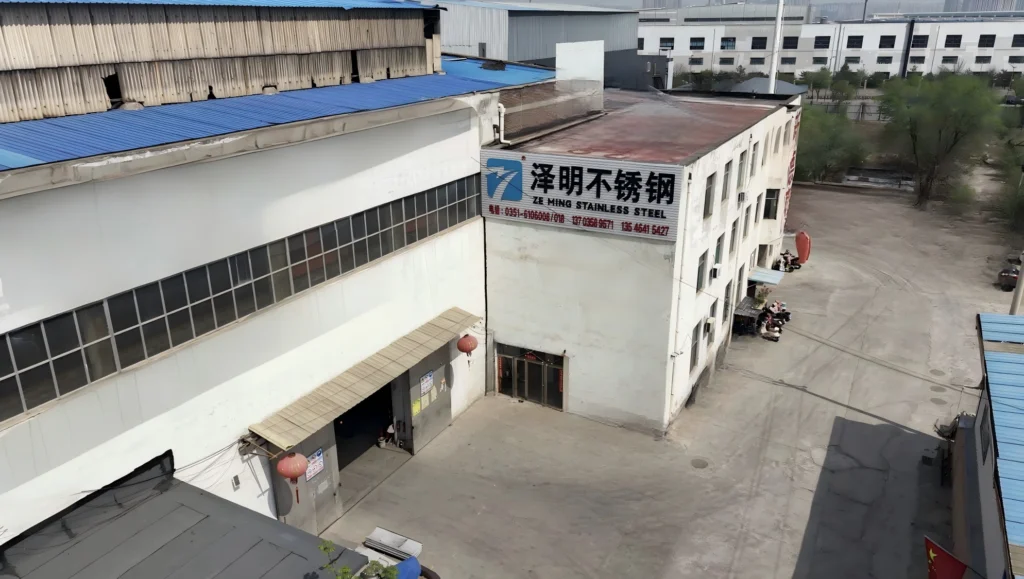
At ZEMSS (Zhuo Er Ming Stainless Steel), we operate one of North China’s most comprehensive duplex stainless steel fabrication facilities, with ASME-qualified welding procedures, ISO 9001/14001/45001-certified quality systems, and in-house metallurgical testing including ferrite measurement and ASTM A923 verification. Whether your project requires a single ASME-coded 2205 pressure vessel or ongoing supply of fabricated spools for an offshore development, our engineering team supports from material selection through final inspection.
Contact our engineering team today to discuss your 2205 duplex stainless steel fabrication requirements. We provide material recommendations, welding procedure review, and a detailed quotation within 48 hours for most project scopes.