
TIG vs MIG Welding for Stainless Steel Fabrication: Choosing the Right Process for Your Parts
By Chen Ming, Senior Fabrication Engineer | June 13, 2026 | 8 min read
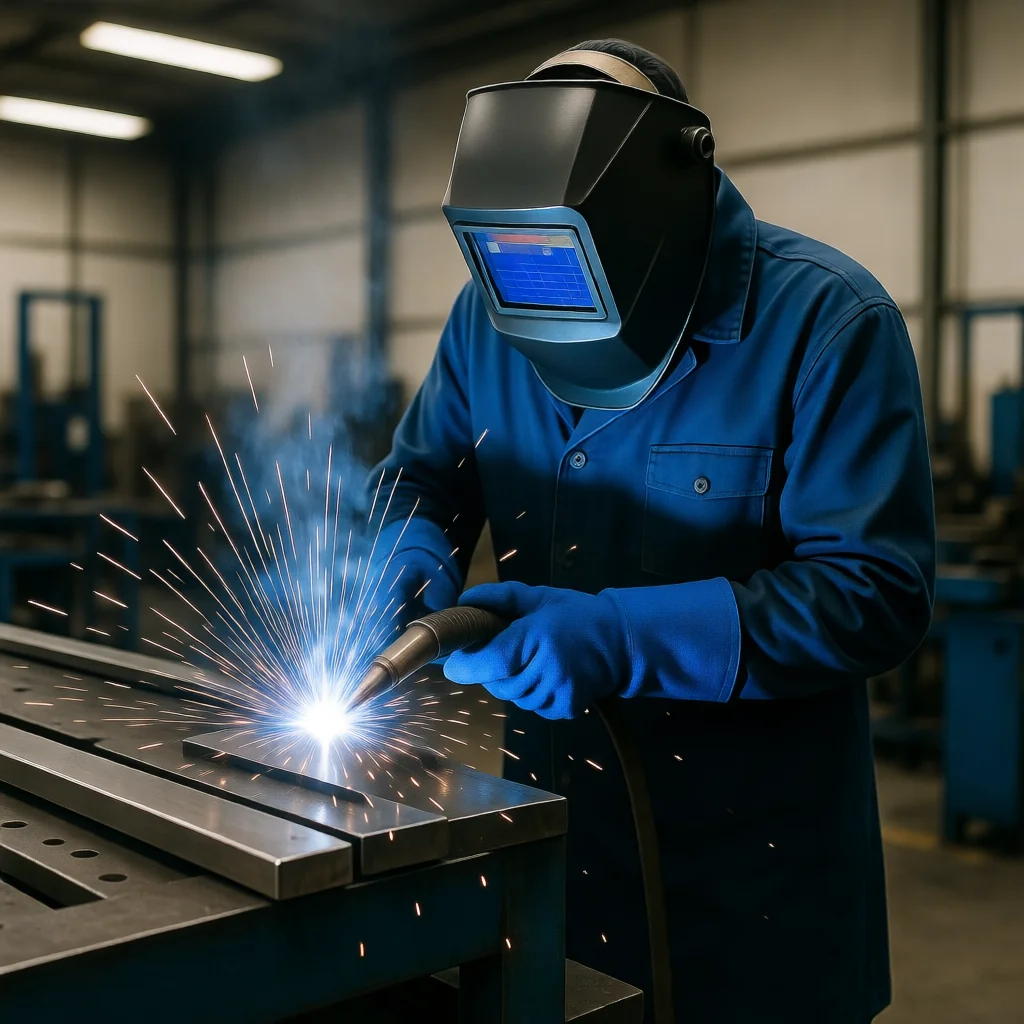
Walk through any stainless steel welding shop floor and you’ll see both TIG torches glowing blue and MIG guns crackling away. When evaluating stainless steel welding guide capabilities,. The two processes coexist because neither is universally better — each dominates specific applications, thickness ranges, and quality requirements. At Zeming, our 10+ certified welders use both TIG (GTAW) and MIG (GMAW) daily, plus submerged arc (SAW) for heavy-section work. This guide breaks down when to choose which process for stainless steel fabrication — based on the metallurgy, not the marketing. See: AWS welding standards.
Stainless Steel Welding Guide: 1. TIG Welding (GTAW) — The Precision Standard
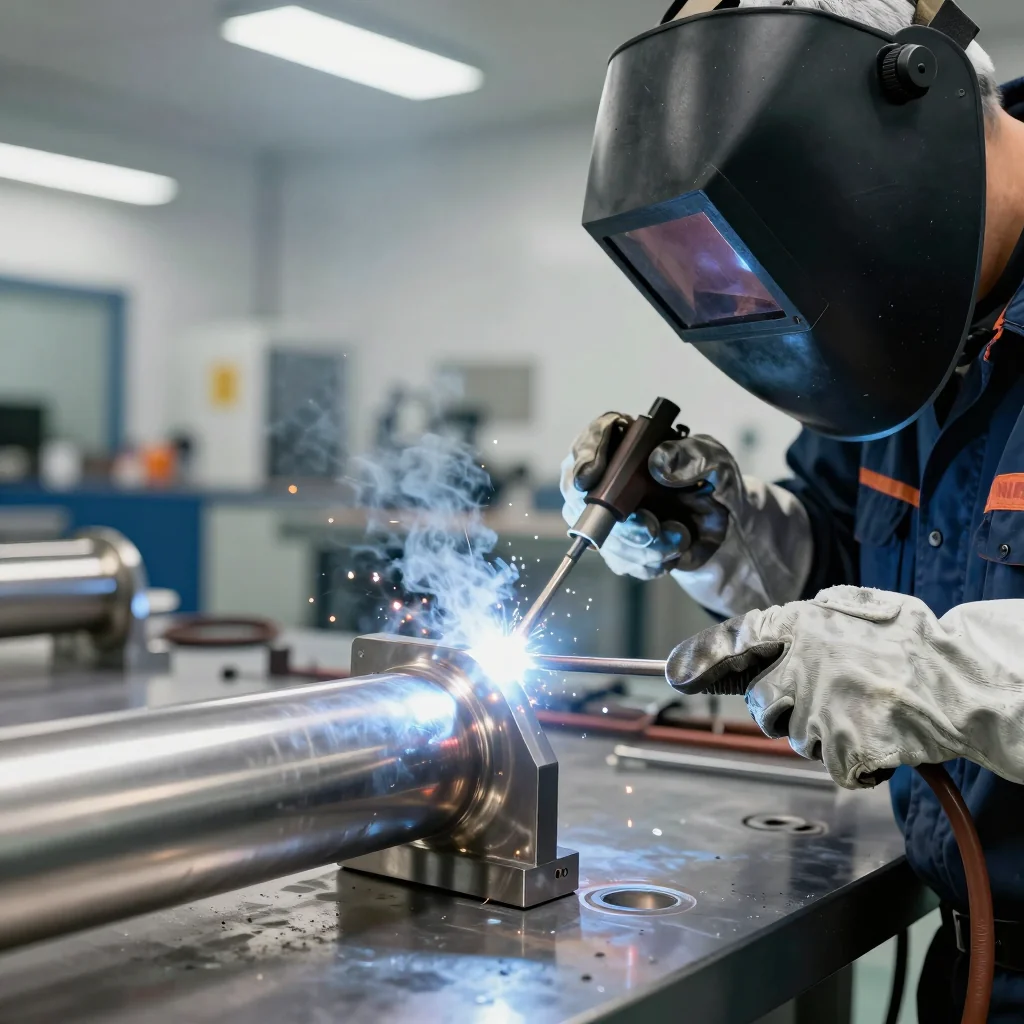
TIG welding stainless steel uses a non-consumable tungsten electrode under inert gas shielding (pure argon or argon-hydrogen). Filler metal is added manually from a separate rod. Because the arc and filler are independently controlled, the welder has fine-grained command over heat input, penetration, and bead profile — making TIG the default choice for the most demanding applications. See: ISO 9606 welder qualification standard.
1.1 Where TIG Wins
- Thin material (≤3mm). TIG’s low minimum amperage and precise heat control prevent burn-through on sheet metal. We routinely TIG weld 0.8mm 304 sheet for instrument enclosures.
- Sanitary and food-grade. The smooth, oxide-free TIG bead profile eliminates crevices where bacteria could harbor — essential for 3-A and EHEDG compliant equipment.
- Pressure piping and vessels. TIG root passes provide full penetration with a smooth internal bead profile — critical for flow characteristics and inspectability in ASME-coded pressure vessels.
- Exotic alloys. Duplex 2205, 904L, and 6% Mo super-austenitics demand the arc precision and heat control that only TIG can deliver.
- Visible/cosmetic welds. Architectural stainless, handrails, and furniture — TIG produces the cleanest appearance with zero spatter.
1.2 Where TIG Struggles
- Speed. TIG deposition rates are 0.5–1.5 kg/hr — roughly 1/3 to 1/5 of MIG. On a 100-meter weld seam, this difference translates to days of additional labor.
- Thick sections (>10mm). Multi-pass TIG on heavy plate is technically feasible but economically painful. Each pass deposits only ~2–3mm of weld metal.
- Operator skill. TIG demands significantly more training and consistency than MIG. A certified TIG welder is a scarcer (and more expensive) resource.
2. MIG Welding (GMAW) — Speed and Productivity
MIG welding stainless steel uses a continuously-fed consumable wire electrode through a welding gun, with shielding gas flowing around the arc. The wire feed serves as both electrode and filler metal — dramatically increasing deposition rate over TIG.
2.1 Where MIG Wins
- Thick plate fabrication (>6mm). MIG spray transfer deposits 3–8 kg/hr of weld metal — welding a 12mm fillet on a structural frame in one or two passes that would take TIG four or five.
- Long production runs. For fabricating dozens of identical stainless frames, brackets, or enclosures, MIG’s speed advantage compounds. Wire feed eliminates the stop-start rhythm of TIG rod changes.
- Position welding. Short-circuit MIG transfer handles out-of-position welds (vertical, overhead) more forgivingly than TIG on thicker sections.
- Cost-sensitive structural work. When the weld doesn’t need to be beautiful — just strong — MIG delivers the required mechanical properties at a lower cost per meter.
2.2 Where MIG Falls Short
- Spatter. MIG inherently produces some weld spatter — tiny droplets that land on adjacent surfaces and must be removed. On cosmetic stainless, spatter cleanup alone can erase MIG’s speed advantage.
- Thin material (<2mm). Minimum MIG amperage often exceeds what thin stainless sheet can tolerate without burn-through.
- Weld appearance. Even optimized MIG beads are less aesthetically refined than TIG. For architectural or consumer-facing stainless, TIG remains the standard.
3. Head-to-Head Comparison
| Parameter | TIG (GTAW) | MIG (GMAW) |
|---|---|---|
| Weld quality (cosmetic) | Excellent — smooth, bright, no spatter | Good — slight rippling, some spatter |
| Weld quality (metallurgical) | Excellent — low heat input, fine grain | Good — higher heat input, coarser grain |
| Penetration control | Precise — independent of filler addition | Good — spray transfer penetrates deeply |
| Deposition rate | 0.5–1.5 kg/hr | 3–8 kg/hr |
| Thin material (<2mm) | Ideal | Difficult — risk of burn-through |
| Thick material (>10mm) | Slow — requires multiple passes | Efficient — fewer passes needed |
| Operator skill required | High — 3–5 years to certify | Moderate — 1–2 years to certify |
| Labor cost per weld-meter | Higher (slower + higher skill premium) | Lower (faster + broader labor pool) |
| Shielding gas | Pure Ar (or Ar + 2–5% H₂) | Ar + 2% CO₂ or He/Ar/CO₂ tri-mix |
| Post-weld cleanup | Minimal — wire brush or pickle paste | Moderate — spatter removal + passivation |
| Best application | Piping, pressure vessels, sanitary, architectural | Structural frames, brackets, heavy plate fab |
4. Gas Selection — The Hidden Quality Driver
Furthermore, Shielding gas isn’t an afterthought — for both TIG and MIG welding stainless steel, the wrong gas mix can ruin an otherwise perfectly executed weld by introducing oxidation, carbon pickup, or phase imbalance.
| Process | Grade | Recommended Gas | Notes |
|---|---|---|---|
| TIG | 304, 304L, 316L | 100% Argon | Standard for all gauges |
| TIG | 304, 316L (thick) | Ar + 2–5% H₂ | Improves fluidity and penetration on >6mm |
| TIG | Duplex 2205 | Ar + 2% N₂ | Maintains austenite-ferrite phase balance |
| TIG | Super-austenitic (904L, 6% Mo) | Ar + 2% N₂ | Prevents nitrogen loss from the weld pool |
| MIG | 304, 304L, 316L | 98% Ar + 2% CO₂ | Good balance of arc stability and low oxidation |
| MIG | 304, 316L (spray transfer) | 90% He + 7.5% Ar + 2.5% CO₂ | Hotter arc, deeper penetration, faster travel |
| MIG | Duplex 2205 | 98% Ar + 2% N₂ | Nitrogen addition preserves phase balance |
Critical rule: Never use CO₂-rich mixes (>5% CO₂) for stainless MIG. Carbon pickup from CO₂ dissociation embrittles the weld and destroys corrosion resistance. The 75% Ar / 25% CO₂ mix ubiquitous in carbon steel shops has no place near stainless.
5. Filler Metal Selection
Weld filler metal must match or slightly over-match the base material in corrosion resistance. Using the wrong filler is one of the most common — and most expensive — mistakes in stainless steel welding.
| Base Metal | TIG Filler Rod (AWS) | MIG Wire (AWS) | Key Consideration |
|---|---|---|---|
| 304 to 304 | ER308 / ER308L | ER308LSi | “L” = low carbon, preferred for corrosion service |
| 304 to carbon steel | ER309 / ER309L | ER309LSi | Higher Cr+Ni to compensate for carbon steel dilution |
| 316L to 316L | ER316L | ER316LSi | 2–3% Mo for pitting resistance matching |
| 2205 to 2205 | ER2209 | ER2209 | Over-alloyed Ni (~8–9%) to ensure phase balance |
| 304 to 316L | ER316L | ER316LSi | Match the higher-alloy side (316L) |
| 310S to 310S | ER310 | — (TIG preferred) | High Cr+Ni for heat-resistance matching |
6. Frequently Asked Questions
Q: Which is better for stainless steel — TIG or MIG?
Therefore, TIG produces higher-quality welds — cleaner, more precise, with better corrosion resistance. It’s the standard for pressure vessels, sanitary equipment, and visible welds. MIG is typically 3–5× faster and more economical for structural fabrications over 6mm thick. The right choice depends on your application, not an absolute ranking.
Q: Can you MIG weld stainless steel without post-weld cleanup?
MIG will produce some spatter and a less aesthetically refined bead. For non-cosmetic structural applications, a stainless wire brush pass may be sufficient. For visible surfaces or corrosion-critical service, MIG welds require post-weld pickling and passivation to fully restore corrosion resistance.
Q: What gas do you use for TIG welding stainless steel?
Pure argon is the standard. For 304/316L sections thicker than 6mm, adding 2–5% hydrogen improves weld pool fluidity. For duplex 2205, we use argon + 2% nitrogen to maintain the correct austenite-ferrite phase balance. Never use CO₂ or oxygen with TIG — they instantly contaminate the tungsten electrode.
Q: How do you prevent carbide precipitation (sensitization) during stainless steel welding?
Consequently, Use low-carbon grades (304L, 316L) with ≤0.03% carbon, control interpass temperature below 150°C, and minimize heat input. For heavy-section welds on standard 304/316 grades, post-weld solution annealing may be required. Our certified welding procedures include heat input limits specific to each grade to prevent sensitization.
7. Making the Right Choice for Your Project
Choosing between TIG and MIG welding for stainless steel comes down to three questions:
- What does the weld need to look like? Visible or sanitary → TIG. Hidden or structural → MIG is viable.
- How thick is the material? Under 3mm → TIG. Over 10mm → MIG is strongly preferred. Between 3–10mm → either, depending on quality requirements.
- What is the production volume? Prototype or low volume → TIG. Production run of identical parts → MIG’s speed pays for itself.
At Zeming, we maintain both TIG and MIG capabilities with certified welders for each process — plus submerged arc welding (SAW) for heavy-section work that neither TIG nor MIG handles efficiently. Send us your drawings and requirements and our engineering team will recommend the right process — not the one we happen to have available, but the one your part actually needs.
Explore our other process capability guides and material selection resources.
About the Author: Chen Ming is a Senior Fabrication Engineer at Shanxi Zeming Environmental Technology Co., Ltd., with 20+ years of hands-on experience in stainless steel welding, forming, and fabrication process engineering.