
By ZEMSS Engineering Team · May 2026 · 8 min read
Stainless steel tree grates appear simple. They sit flush in the paving, protect the root zone, let water through. But specify the wrong grade for a coastal site, get the slot width wrong for a pedestrian zone, or underspec the load rating — and you will be replacing them within two years.
We have fabricated stainless steel tree grates, drainage grates, and concealed manhole covers at our Taiyuan facility for municipal and landscape projects in multiple countries. This guide is based on what we see repeatedly in the enquiries we receive — the questions contractors ask, the specification errors that cause problems, and the decisions that determine whether a grate lasts five years or twenty-five.
Why Stainless Steel, Not Cast Iron or Galvanised Steel
Cast iron has been the traditional material for tree grates. It is cheap and heavy, but it corrodes in coastal environments, requires painting and maintenance, and is increasingly targeted by metal thieves due to its scrap value.
Galvanised steel corrodes at cut edges and weld zones over time, particularly in coastal or de-icing salt environments.
Stainless steel offers:
- Maintenance-free appearance — no painting, no coating renewal, no rust staining on adjacent paving
- Theft resistance — stainless steel has low scrap value compared to cast iron and bronze
- Custom fabrication — any diameter, any slot pattern, any frame profile, cut from your DXF file
- Long service life — correctly specified stainless tree grates last 25+ years in urban environments
- Design flexibility — laser-cut decorative patterns, Chinese traditional motifs, geometric arrays — all achievable in the same material
The trade-off is upfront cost. Stainless steel tree grates cost more than cast iron on a per-unit basis. On a whole-life cost basis — including maintenance, repainting, replacement, and disruption — stainless steel is typically lower cost over a 20-year horizon.
Grade Selection: 304 or 316L
This is the most important specification decision and the one most commonly made incorrectly.
Use 304 when:
- The site is inland, more than 5km from the coast
- There is no regular de-icing salt application in winter
- The surrounding environment is a standard urban or suburban plaza
Use 316L when:
- The site is coastal — within 5km of the sea, or directly on a waterfront promenade
- De-icing salts are applied to adjacent roads or pathways in winter
- The grates will be installed near swimming pools, fountains, or other chlorinated water sources
- The project specification explicitly requires 316L (increasingly common in UK and European public realm standards)
The reason: 316L contains 2–3% molybdenum, which resists the chloride-induced pitting that causes rust staining on 304 in marine and salt-exposed environments. A 304 tree grate installed on a coastal promenade will begin showing rust spotting within 12–18 months. A 316L grate on the same site will remain clean for decades.
What we see in practice: the single most common error in the enquiries we receive is 304 being specified for waterfront or coastal plaza projects. Sometimes it is a cost decision; sometimes the specifier is not aware of the difference. In almost every case, we flag it and recommend 316L with a cost comparison. The material premium on a finished grate is typically 15–25% per unit. The cost of replacement — including removal, re-paving, logistics, and new fabrication — is several times that.
The material cost difference between 304 and 316L plate is approximately 20–30%. On a finished tree grate, the difference per unit is typically modest relative to the total project cost. Always specify 316L for coastal and de-icing salt environments.
Key Specifications to Define Before You Order
1. Outer Diameter and Frame Profile
Tree grates are typically round or square. Common diameters for round grates range from 600mm to 1,500mm, with 900mm, 1,000mm, and 1,200mm being the most frequent specifications for urban streetscapes. Square grates are typically specified in 600×600mm, 800×800mm, or 1,000×1,000mm formats.
The frame (surround) profile — flat, angled, or rebated — depends on how the grate integrates with the adjacent paving system. Provide a cross-section drawing of your paving build-up and the grate manufacturer can design the frame to match.
2. Slot Width: Heel-Safe Requirement
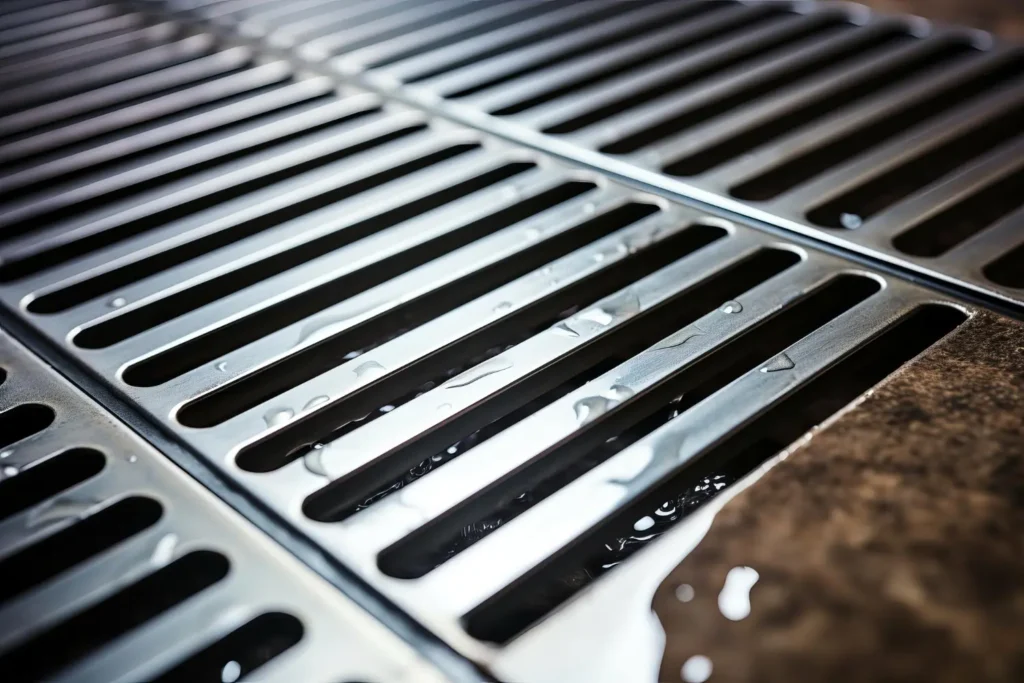
For pedestrian zones, slot width is a safety-critical specification. The maximum acceptable slot width to prevent heels and assistive device tips from becoming trapped is generally 13mm (½ inch). This aligns with the ADA Standards for Accessible Design in the United States, which specifies that openings in ground surfaces in accessible routes must not permit passage of a sphere more than 13mm in diameter. Equivalent accessibility standards apply in the UK and EU.
Laser cutting allows slot widths to be held to ±0.5mm across the full grate diameter — a precision that cast iron casting cannot match. Specify 10–13mm for standard pedestrian zones. Wider slots are acceptable in vehicle-only areas where pedestrian foot traffic is excluded.
From production: we regularly receive drawings without a slot width dimension, or with a note that says “to match existing cast iron grates.” Cast iron grates are typically cast with 15–18mm slot widths — too wide for heel safety. We default to 12mm unless instructed otherwise and flag any drawing that specifies above 13mm in a pedestrian zone.
3. Slot Pattern
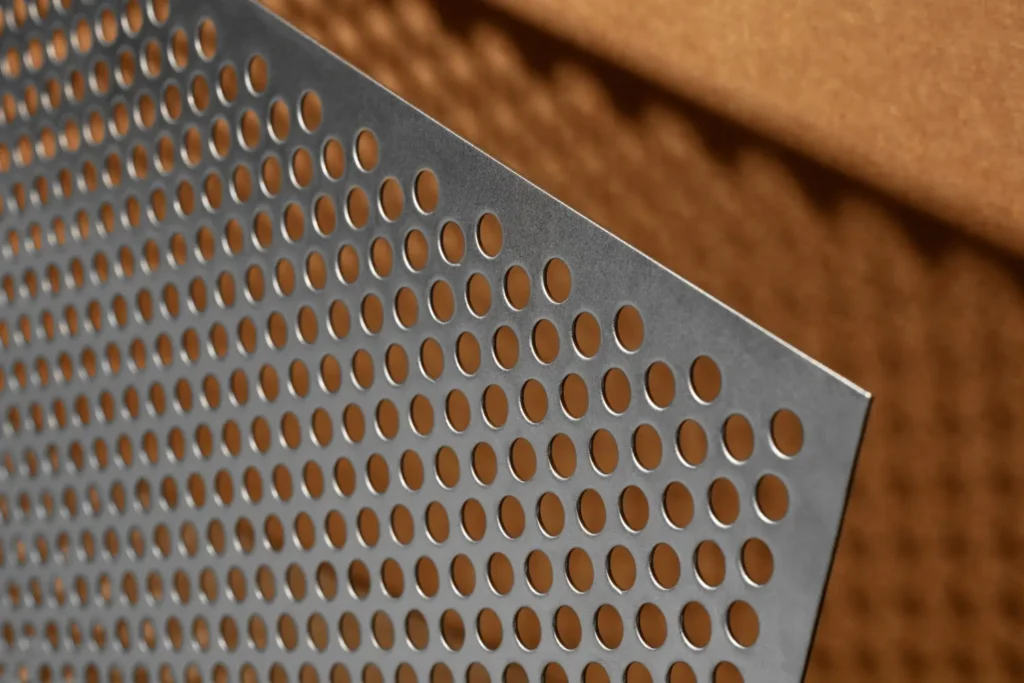
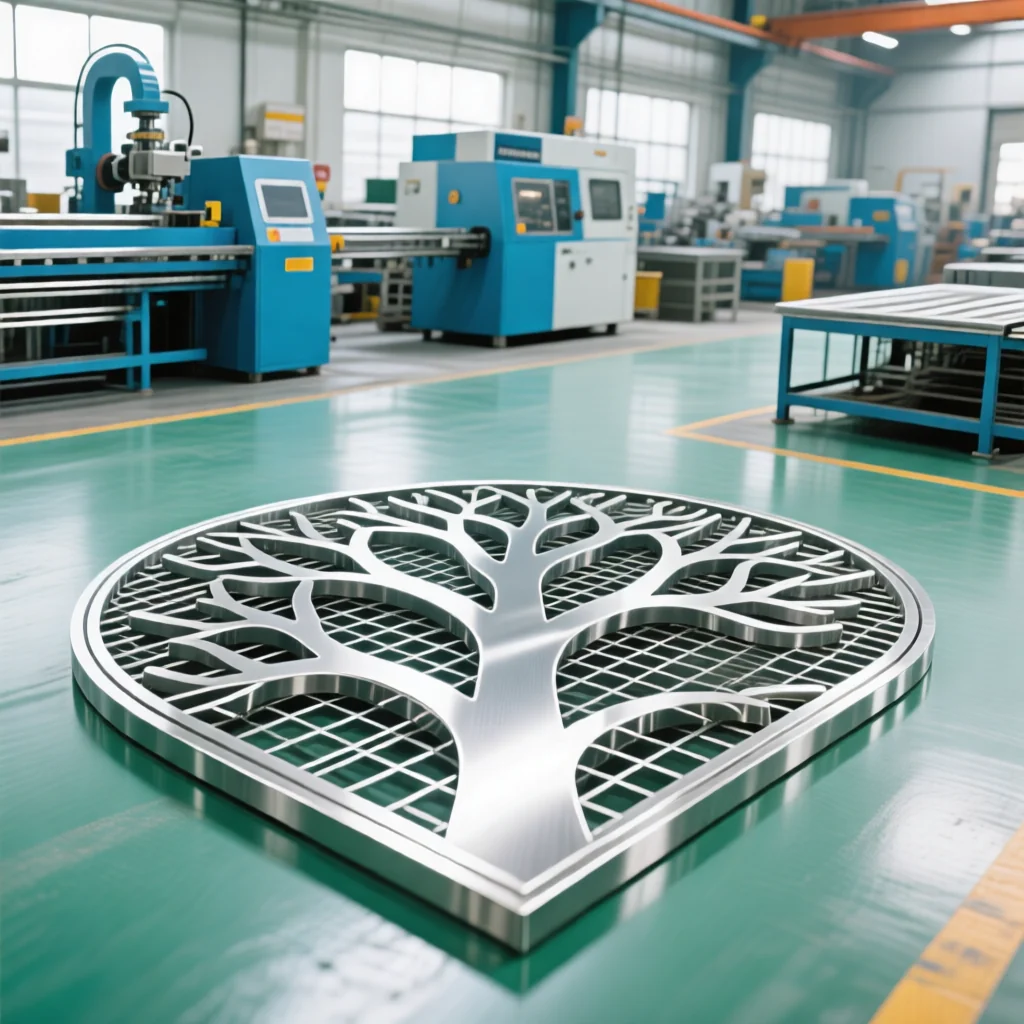
Standard patterns include radial slots (running from centre outward), concentric ring slots, and grid/mesh apertures. For decorative installations, any pattern can be laser-cut from a DXF file — traditional geometric motifs, botanical patterns, city emblems, project-specific artwork.
Open area percentage (the proportion of the grate that is open for water and air passage) affects root health. A minimum of 25–30% open area is generally recommended by urban forestry guidelines for tree grates in paved environments.
4. Load Rating
Load rating determines the wall thickness and bar spacing of the grate structure. The European standard EN 124 defines the load classes most commonly referenced in international specifications:
| Load Class (EN 124) | Test Load | Typical Location |
|---|---|---|
| B125 | 125 kN | Pedestrian and cyclist areas only |
| C250 | 250 kN | Car parks, kerb zones with occasional car overrun |
| D400 | 400 kN | Carriageways, roads, car parks with regular vehicle traffic |
Provide your load class requirement to the manufacturer. They will engineer the grate thickness and frame profile to meet it and can provide a load calculation if required for project approval.
What we see in practice: the majority of municipal pedestrian plaza projects we receive specify B125. Errors occur when grates are installed near delivery bays or loading areas that were not originally anticipated — a vehicle overrun on a B125-rated grate causes permanent deformation. When the installation location has any ambiguity about future vehicle access, we recommend specifying C250 as a precaution. The additional material cost is small relative to the replacement cost.
5. Surface Finish
Standard finishes for urban tree grates:
- No.4 Brushed / Satin — the most common finish for urban applications. Unidirectional grain, medium reflectivity, conceals surface marks well.
- Shot-blasted matte — low reflectivity, non-directional texture, good anti-slip properties, blends with stone paving aesthetics.
- Mill finish (2B) — smooth, low reflectivity, lower cost. Suitable where appearance is not a primary consideration.
- Mirror polish (No.8) — high reflectivity, used for decorative feature installations. Shows marks more readily.
Custom Fabrication vs Catalogue Products
Cast iron tree grates are typically catalogue products — fixed sizes, fixed patterns, take it or leave it. Stainless steel tree grates are almost always fabricated to order.
This is an advantage, not a limitation. It means:
- Any diameter that fits your tree pit layout
- Frame profile matched to your paving depth and edge detail
- Slot pattern from your project’s DXF artwork file
- Split grates (two or three segments) for installation around established trees without lifting the rootball
- Integrated irrigation ports, aeration tubes, or anchoring lugs if required
MOQ for custom stainless steel tree grates is typically 1 piece. Small prototype batches for client approval are feasible before committing to a full production run.
Common Specification Mistakes — and How We Handle Them
Based on the enquiries and drawings we receive, these are the errors that come up most often:
- No grade specified, only “stainless steel” — we ask about the site location and chloride environment and recommend 304 or 316L accordingly. Without this information, any price we give is provisional.
- Slot width copied from cast iron catalogue — cast iron grates typically have 15–18mm slots, which exceed heel-safe limits. We flag this and default to 12mm unless the customer confirms a non-pedestrian zone.
- Diameter specified without frame detail — the grate diameter alone is not enough. We need to know the paving depth, the tree pit edge detail, and whether the frame needs a rebate for flush fitting. We send a standard frame detail drawing for customers to mark up.
- No DXF file for custom patterns — customers sometimes send a photo of a pattern they want replicated. We can work from a photo, but a DXF file produces faster quoting and more accurate cutting. If the pattern came from an earlier cast iron installation, we redraw it in CAD at a small setup charge.
- Load class not stated — we ask. We do not assume. A grate installed in the wrong load zone is a liability risk for the contractor and the client.
What to Check When Sourcing from a Manufacturer
Whether you are sourcing from a local fabricator or from a manufacturer in China, ask for the following before placing an order:
- Material test report (MTR) — confirms the actual grade, heat number, and chemical composition of the steel used. The material should conform to ASTM A240 or EN 10028-7 for plate, or equivalent. A reputable manufacturer provides this as standard, not on request.
- Dimensional inspection report — confirms that the finished grate matches the approved drawing dimensions within tolerance.
- Quality certification — ISO 9001 certification is the baseline quality management standard. Verify it is current and covers fabrication, not just trading.
- Sample or prototype — for orders above a threshold quantity, request a sample unit for physical approval before production begins.
- Weld inspection — if the grate includes welded components, ask whether visual weld inspection is conducted and whether records are kept.
- Export packaging — grates must be protected against surface damage in transit. Ask about packaging method (wooden crate, PE film, edge protection) before shipping.
Sourcing Stainless Steel Tree Grates from China: What to Expect
China manufactures the majority of the world’s stainless steel and has substantial fabrication capacity for laser-cut urban infrastructure components. Price advantage over European manufacturers is typically 40–60% on equivalent specifications.
Key considerations when sourcing from China:
- Lead time: Allow 20–35 days from approved drawing to EXW (ex-works). Add transit time: approximately 25–35 days by sea to European ports, 20–30 days to US West Coast ports.
- Drawing submission: Provide DWG, DXF, or a fully dimensioned PDF. Ambiguous specifications result in rework and delay. The more complete your drawing package, the faster and more accurate the quotation.
- MOQ flexibility: Manufacturers with their own laser cutting equipment (rather than outsourcing) can accept MOQ of 1 piece. Confirm this before ordering if you need a prototype quantity.
- Incoterm: FOB (Free On Board) is the most common arrangement. The manufacturer delivers to the named port in China; your freight forwarder handles the ocean freight and import clearance.
- Quality verification: Request photos of the finished product before shipment authorisation. For large orders, consider third-party pre-shipment inspection.
Frequently Asked Questions
What grade of stainless steel should I use for tree grates?
Use 304 stainless steel for inland sites in non-coastal environments. Use 316L for coastal sites within 5km of the sea, waterfront plazas, or any location where de-icing salts are applied in winter. 316L contains molybdenum which prevents the chloride-induced pitting that causes rust staining on 304 in marine environments.
What slot width is required for heel-safe tree grates?
Most accessibility standards specify a maximum slot width of 13mm (0.5 inch) for pedestrian zones to prevent heels and cane tips from becoming trapped. ADA guidelines in the United States and similar European standards both reference this dimension. Always confirm the applicable local standard with your project engineer.
Can stainless steel tree grates be made to custom sizes?
Yes. Unlike cast iron tree grates which come in fixed catalogue sizes, stainless steel tree grates are fabricated to order. A manufacturer can produce any diameter, frame profile, and slot pattern from your DWG or DXF drawings. MOQ is often as low as 1 piece for prototype or small municipal projects.
What load rating do tree grates need?
Pedestrian-only zones typically require a minimum load class of B125 (125 kN) per EN 124. Locations with occasional vehicle overrun need C250 or D400. The wall thickness and bar spacing must be engineered to the specified load class — always provide your load requirement to the manufacturer.
How long does it take to manufacture custom stainless steel tree grates?
Lead time for custom stainless steel tree grates is typically 20–35 days from approved drawing, depending on quantity and complexity. Small prototype quantities (1–5 pieces) can sometimes be completed in 10–15 days. Production batches of 50–200 pieces generally take 25–40 days.
Order Stainless Steel Tree Grates from ZEMSS
ZEMSS fabricates stainless steel tree grates in 304 and 316L at our Taiyuan factory. We laser-cut slot patterns from your DXF files, fabricate frames to your paving depth, and ship with full material test reports and dimensional inspection certificates. MOQ from 1 piece.
We have supplied tree grates, drainage grates, and concealed manhole covers for urban landscape and public realm projects across multiple countries. Our factory holds ISO 9001, ISO 14001, and ISO 45001 certification.
To request a quotation, send us:
- Grate diameter or dimensions (mm)
- Slot pattern (standard radial, or your DXF file)
- Grade: 304 or 316L
- Surface finish: brushed / shot-blasted / other
- Load class requirement
- Quantity and destination port
Pingback: Recessed Stainless Steel Manhole Covers: Spec Guide — ZEMSS